

Adapting to New Aerial Threats: Ukraine’s Volunteer Defense Units
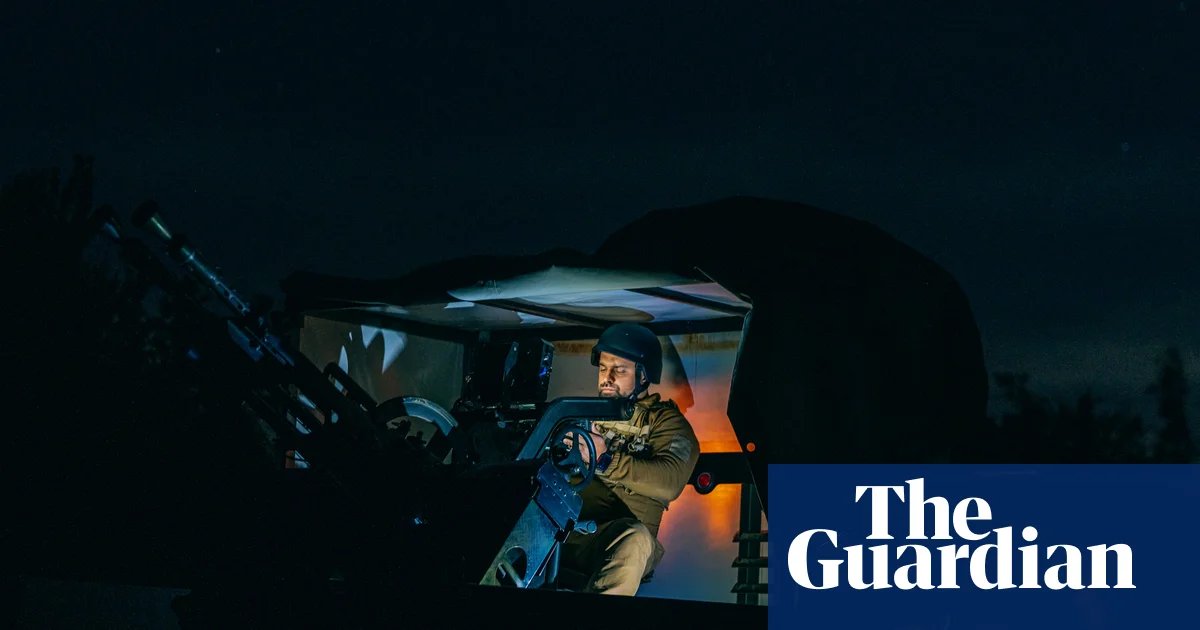
As Kyiv’s nighttime curfew envelops the city, much of its landscape remains shrouded in darkness and silence. However, on the rooftop of a towering structure at the city’s edge, a vigilant group of uniformed men stands guard, manning heavy machine guns and scanning the skyline. Suddenly, a drone buzzes into view. Unlike before, when such sounds would send the men into a frenzy, this time they calmly monitor its speed and altitude from their screens, deciding on their course of action. Unfortunately, this particular drone is an advanced Russian model, capable of jet-like speeds that have dramatically altered aerial warfare over Kyiv in a matter of months.
The Challenges of Modern Warfare
“They’re incredibly fast; hitting them is nearly impossible, as our weapons can’t reach them,” remarks Sensei, the commander, as he surveys the distant skyline. The Guardian spent three days with Mriya, Kyiv’s largest volunteer air-defense group, observing their operations from rooftops to mobile units stationed in remote fields surrounding the capital. With the onset of Russia’s full-scale invasion, Ukraine has relied heavily on a dedicated corps of unpaid volunteers, equipped mostly with outdated Soviet-era arms, to fortify the airspace over its cities and protect families.
Living Two Lives
These volunteers have proven to be an essential part of Ukraine’s response to Russian drone assaults, particularly against Iranian-made Shaheds, known as Geran-2 in Russia. “We live a double life,” shares Oleksandr, a lawyer who operates a machine gun mounted on a truck in a field outside the city. “During the day, I handle legal matters, while at night, I’m engaged in downing drones. It’s odd but you eventually acclimatize.”
The Evolving Drones
Warfare in Ukraine progresses rapidly, and struggling units like Mriya are facing new challenges. Recently, Russia has increasingly deployed jet-powered drones, which can zip along at around 600 km/h (373 mph) and soar up to 10 km (6 miles) high—far beyond the reach of the volunteers’ machine guns. Currently, Ukraine’s success rate in intercepting these new drones stands at around 50% to 60%.
The Reality on the Ground
Artem, a seasoned military veteran, recalls a time back in 2023 when they could take down multiple Shaheds in one night. Now, they have only succeeded in downing one jet drone after it slowed enough to be targeted. “There’s a sense of helplessness,” he admits. The issue lies in the design of the machine guns’ sights, which are tailored for slower targets. “The Shahed is no longer a target our aiming grid can manage,” he laments.
Layered Defense Strategies
Ukraine’s air defense is structured as a multi-tiered system, pairing different weapons with various threats. Volunteer teams equipped with machine guns work in tandem with interceptor drones to track slower, low-flying Shaheds. However, to counter missiles or fast-flying drones, more advanced systems like the limited US-made Patriot batteries are necessary.
Increased Attacks
As Russia escalates its air operations, utilizing jet drones has coincided with a slowdown in its ground assaults, leading to almost daily strikes on Kyiv. These attacks have wreaked havoc on bridges across the Dnipro, resulting in restrictions on several major thoroughfares. Recently, missile bombardments and drone attacks have caused renewed disruptions to the city’s electricity and water supplies, disrupting what was once considered a relatively safe urban environment.
Volunteers on the Front Lines
The volunteers of Mriya reflect a cross-section of Kyiv’s populace, including a creative director, a handyman, a self-defense coach, and a former design institute head. While the military supplies them with heavy machine guns, including the American-made Browning M2 and Soviet-era DShK, the volunteers purchase their own vehicles, fuel, and gear. They share a unified purpose, underscored by the knowledge that a single drone could endanger their loved ones.
Personal Stakes
“If a drone gets through, it has the potential to harm our families,” argues Ivan, a university professor who joined Mriya after a Shahed struck his home. “It terrified my family and damaged our property. I have a personal stake in this—two kids depend on me.” During shifts that extend into daylight, he even holds classes online, demonstrating the blend of duty and personal responsibility.
Hope on the Horizon
Help may soon come in the form of new technology. Artem shares a tablet featuring live updates on drone activity over Ukraine, showcasing new high-speed interceptor drones developed by local companies to counter Russian aerial threats. However, there are hurdles to overcome. According to Stanislav Hryshyn, a co-founder of a leading drone manufacturer, building the needed interceptor capacity requires overcoming shortages of small jet engines, primarily sourced from China.
A Race Against Time
Hryshyn estimates that it may take three to four months to produce enough interceptors to match the new threats posed by the jet drones. Even with an influx of new technology, the ongoing arms race means that any advantage may be fleeting. Russia continuously adapts its drones, posing new challenges for Ukraine’s air defenses. “It’s a constant race,” Hryshyn observes. “A race where lives are at stake.”
Conclusion
The struggle to secure the skies above Kyiv epitomizes the evolving nature of warfare in Ukraine. As volunteer defenders become an increasingly vital part of air defense, they face the daunting task of keeping pace with rapidly changing enemy tactics. While new interceptors may offer hope, the ongoing battle demands resilience and innovation from those tasked with defending their homeland.
Key Takeaways
- Kyiv relies on a dedicated volunteer air defense force to combat evolving drone threats.
- New Russian jet-powered drones pose significant challenges that outpace older defense systems.
- The stakes are personal for many volunteers, as their families’ safety is directly impacted by drone incursions.
- Innovation in interceptor technology may provide critical support in the ongoing aerial conflict.