

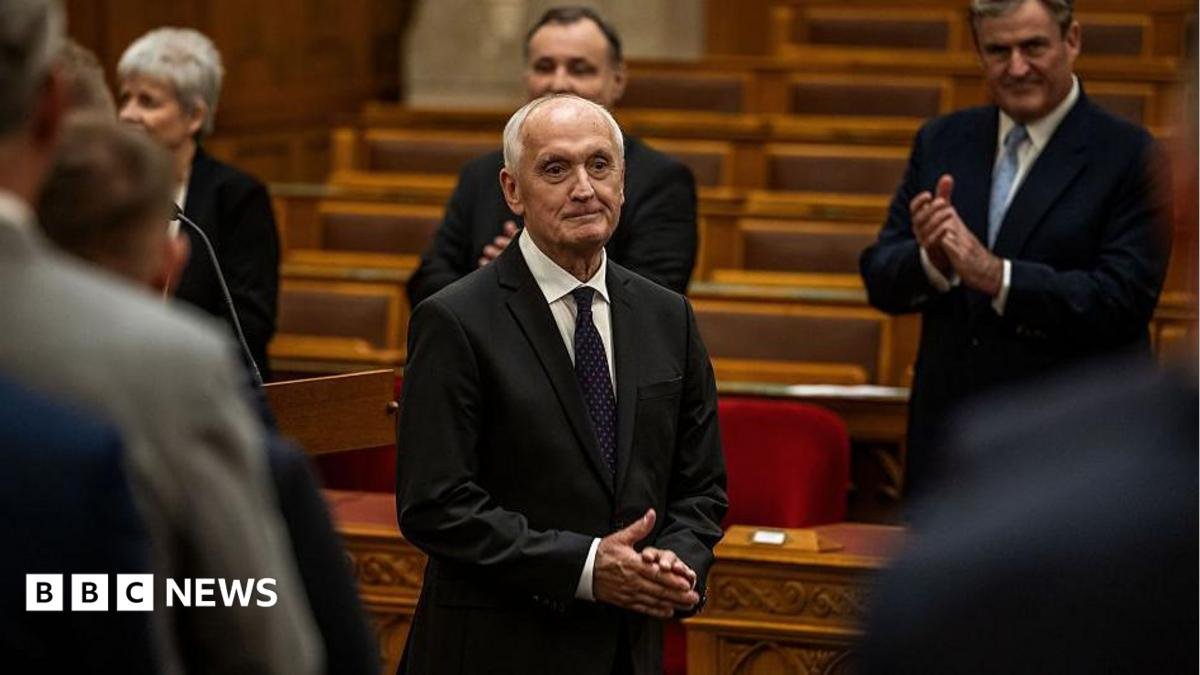
András Baka Elected as Hungary’s Head of State
Hungary’s parliament has recently appointed András Baka, a distinguished 73-year-old jurist and former chief justice, as the country’s new head of state. While the role of the Hungarian president is predominantly ceremonial, Baka’s leadership is anticipated to be anything but uneventful. His primary responsibility will be to oversee Prime Minister Péter Magyar’s ambitious initiatives aimed at dismantling the extensive socio-political and economic structures created by former Prime Minister Viktor Orbán. Additionally, Baka will spearhead the drafting of a new constitution, replacing Orbán’s 2011 framework.
Commitment to Unity and Hope
Upon his election, which passed with a decisive vote of 140 to 6, Baka addressed the parliament, stating, “We cannot build the new Hungary on revenge.” He emphasized that while many citizens are filled with a sense of hope and newfound freedom, others grapple with disappointment and uncertainty. “In a democratic society, this is not an anomaly but a natural state of affairs,” he remarked, underlining the importance of acknowledging diverse perspectives within the nation.
Notably, the election process was marked by tension; all 51 members of Orbán’s Fidesz party walked out of the chamber in protest against the removal of their preferred candidate, Tamás Sulyok. Baka, in his address, committed to fostering a comprehensive dialogue regarding the new constitution, pledging to include a wide range of viewpoints.
Swift Reforms by the New Administration
Since taking office in early May, the Magyar government has aggressively targeted Orbán’s legacy. They have enacted 27 new laws, along with two constitutional amendments. Among the significant changes, the states of emergency related to migrants, COVID-19, and the war in Ukraine—tools Orbán leveraged to exercise decree power—have been abolished. Additionally, the Sovereignty Protection Office, previously utilized by Fidesz to attack dissenting journalists and NGOs, has been disbanded, replaced by the National Asset Recovery and Protection Office, which is empowered to probe and prosecute individuals suspected of financial misappropriation during the previous administration.
Fidesz has criticized the Tisza government, labeling it a “tyranny,” particularly given that Baka was expelled from his role as president of the Supreme Court in 2011 for resisting their attempts to undermine legal standards.
Media Independence and Constitutional Amendments
Public service broadcasts have been suspended since July 9, allowing time for a thorough rebranding aimed at restoring media independence and distancing them from their former function as governmental mouthpieces. Moreover, Amendments 16 and 17 have introduced significant reforms, capping the prime minister’s tenure at two terms and limiting MPs to three terms. The Constitutional Court’s authority, which was previously stripped by Fidesz, has also been reinstated to supervise legislative actions.
Presidential Expectations and Views
Those within the Tisza majority may be in for a surprise if they expect Baka to be a docile president. In a prior BBC interview, he voiced his opposition to term limits for MPs, deeming it an infringement on voters’ rights to select their representatives freely. Having served 17 years as Hungary’s judge on the European Court of Human Rights in Strasbourg, Baka reiterates that he is not a conventional political figure. “I got involved in politics through my professional, legal way of thinking,” he explained.
Baka’s presidency is transitional; under the constitutional amendment permitting his appointment, it is likely that he will serve only until the new constitution is established or for a maximum of five years.
Vision for a People-Centric State
As he concluded his speech in parliament, Baka articulated a vision aimed at countering Hungary’s historical inclination toward autocratic leadership. “The state is not there for itself,” he affirmed, “it is there for the people.” This declaration sets the stage for what might be a transformative period in Hungary’s governance.
Conclusion
András Baka’s election as Hungary’s head of state signifies a critical juncture for the nation as it navigates the complexities of transitioning from a legacy of powerful leadership to a more democratic and inclusive model. His tenure may foster the dialogue and reform necessary for establishing a more just society.
- András Baka elected as Hungary’s president, taking over a largely ceremonial role.
- Baka plans to oversee the creation of a new constitution to replace Orbán’s framework.
- Major reforms initiated by the new government aim to dismantle Orbán’s political legacy.
- Baka emphasizes the importance of a government that serves the people, not itself.