

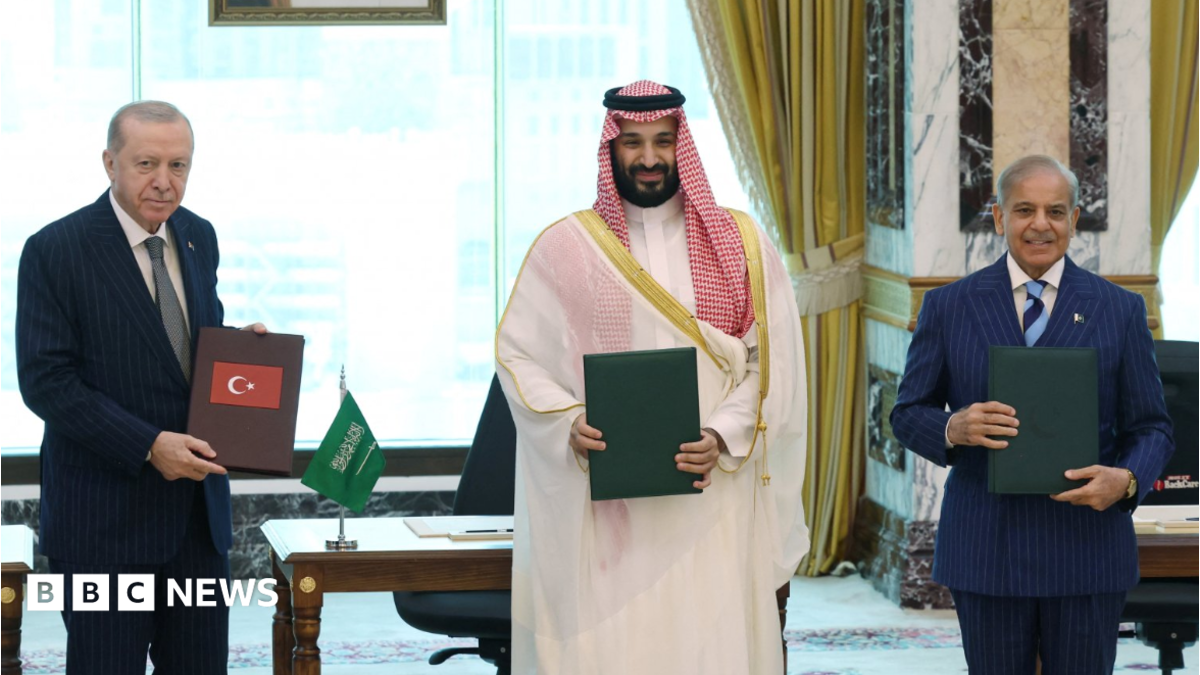
Saudi Arabia, Turkey, and Pakistan Forge a Defense Pact
In a significant move to bolster security cooperation, Saudi Arabia, Turkey, and Pakistan have formalized a joint defense agreement. This pact asserts that an attack against any one of these nations will be interpreted as an attack against all three, a commitment underscoring their solidarity in a turbulent region.
Details of the Agreement
The announcement came during a high-profile meeting held in Mecca, where Saudi Crown Prince Mohammed bin Salman joined forces with Turkish President Recep Tayyip Erdogan and Pakistani Prime Minister Shehbaz Sharif. This collaborative effort aims to strengthen security ties, especially in light of the escalating tensions involving the US and Iran, which have considerably impacted the maritime routes through the Strait of Hormuz—a vital oil transit channel—and the Red Sea.
Background and Context
Prior to this joint agreement, Saudi Arabia and Pakistan had already established a defense pact last year. The new Mecca Joint Defense Agreement now brings together three influential Muslim nations, providing mutual defense guarantees. As the joint statement highlights, the pact is designed “to strengthen collective deterrence against any act of aggression,” ensuring that any armed assault on one nation will be considered an assault on all three.
Mutual Support and Obligations
While the agreement offers a vow of mutual support, it lacks detailed specifications regarding each nation’s responsibilities. A Turkish official reiterated to media that the agreement is “purely defensive in nature,” emphasizing its intention to act as a protective measure rather than an offensive initiative.
Strategic Interests of Each Nation
Each of the three nations brings its own unique strengths to the table and has distinct motivations for entering this pact. For Saudi Arabia, it serves as an additional layer of security in a region dramatically affected by the ongoing conflict between the US and Israel against Iran. Following a significant attack by the US and Israel on Shia-majority Iran, Iran and its allies retaliated by targeting Saudi Arabia and other Gulf states, including blockade measures against shipping routes—actions that were once deemed unlikely.
Tensions in the Region
Just last month, the Iran-aligned Houthi rebels from Yemen declared a “maritime embargo” against Saudi Arabia, targeting its airports, oil facilities, and vessels within the Red Sea. This evolving landscape emphasizes the necessity of the newly formed defense agreement, as regional stability remains precarious.
Conclusion
The joint defense pact between Saudi Arabia, Turkey, and Pakistan marks a pivotal development in Middle Eastern geopolitics. In an age of uncertainty, their solidarity aims to secure mutual interests and bolster deterrence against potential aggressions.
Key Takeaways
- The agreement pledges mutual defense among Saudi Arabia, Turkey, and Pakistan.
- It underscores a unified response to potential military threats in the region.
- The pact follows heightened tensions involving the US, Iran, and regional threats.
- Each country has unique interests and strengths contributing to this alliance.