

Aung San Suu Kyi Transitioned to House Arrest by Myanmar’s Junta Chief
In a significant development, Myanmar’s junta chief-turned-president, Min Aung Hlaing, has ordered Aung San Suu Kyi to be moved to house arrest, marking a notable shift five years after she was detained during a military coup. This action raises questions about the future of political dynamics in the Southeast Asian nation.
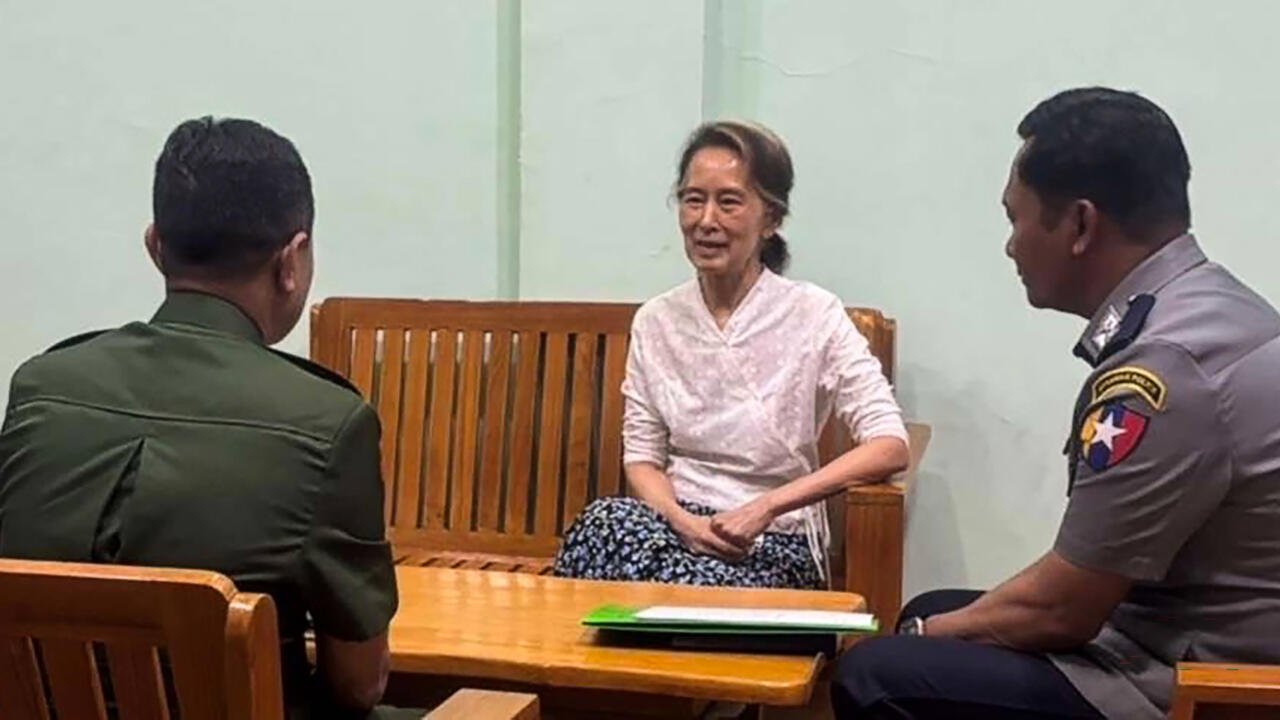
A statement from Min Aung Hlaing’s office indicated that Suu Kyi, now 80 years old, has had her remaining sentence converted to house arrest rather than continuing in a prison environment. A photo released appears to show Suu Kyi seated between two men—one in military attire and the other in a police uniform.
While the exact location of her new address is not publicly known, sources from her dissolved National League for Democracy (NLD) party suggest she will likely remain in a location within the capital, Naypyidaw. One party insider, who requested anonymity for safety, mentioned, “We do not know where it is exactly.”
A police official in Naypyidaw confirmed that security forces had been instructed to implement restrictions in various parts of the capital as of Thursday night. They stated that the “designated residence” will remain under direct security surveillance.
Interestingly, the official communication did not clarify the length of time left in Suu Kyi’s sentence, adding to the uncertainty surrounding her situation.
International Reactions and Backlash
In the United States, United Nations spokesperson Stephane Dujarric described the move as “a meaningful step towards conditions conducive to a credible political process.” However, Suu Kyi’s lawyers expressed cautious optimism. Francois Zimeray and Catalina de la Sota stated that while they appreciated the developments, they emphasized that she remains unjustly imprisoned.
Critics have pointed out that these adjustments are merely tactical maneuvers by the military government. As military chief, Min Aung Hlaing previously oversaw the ousting of Suu Kyi’s democratically elected administration, detaining her on various charges regarded as frivolous by human rights organizations. This event ignited a protracted civil conflict that has claimed thousands of lives and displaced millions within the country, which has a population of approximately 50 million.
Earlier this month, Min Aung Hlaing assumed the presidency as part of a tightly controlled election that notably excluded the NLD. Reports indicate that suppressing dissent during this election could lead to prison sentences of up to ten years, and various regions affected by conflict were not included in the voting process. Observers suggest that this election was more of a rebranding meant to legitimize military rule rather than a genuine democratic exercise.
The junta’s recent actions, which include some relaxation of post-coup restrictions and limited prisoner amnesties, have been viewed by analysts as superficial attempts to improve the regime’s image. Kim Aris, Suu Kyi’s son, criticized these developments, stating, “They’re playing their same usual games. They’re trying to legitimize themselves in the eyes of international media and governments.” He further expressed hope that if his mother truly is under house arrest, she would regain access to communication with family and legal representatives, noting that he had not been able to contact her.
Despite being isolated for a long time, Suu Kyi continues to enjoy immense support within Myanmar. Nevertheless, her family has raised alarms about her deteriorating health. Among the early actions of Min Aung Hlaing as president was the pardon of Suu Kyi’s prominent aide, Win Myint, who previously served as her ceremonial president.
- Myanmar’s junta chief ordered Aung San Suu Kyi to house arrest after five years of detention.
- The move has prompted mixed reactions, with some viewing it as a political maneuver.
- Suu Kyi’s lawyers continue to assert that she has been wrongly imprisoned.
- International observers remain critical of the military’s tactics in consolidating power.