

Debunking the Fake Report on Zelensky and the Stolen Cézanne Painting
Recently, a fabricated report falsely accusing Ukrainian President Volodymyr Zelensky of showcasing a stolen painting has been making rounds on social media. This misinformation began circulating on X on April 21, with the claim being that a piece by the famed French artist, Paul Cézanne, could be seen in a video shared by Zelensky. Below, we unpack the details and the origins of this deceptive narrative.
The Fake Report Explained
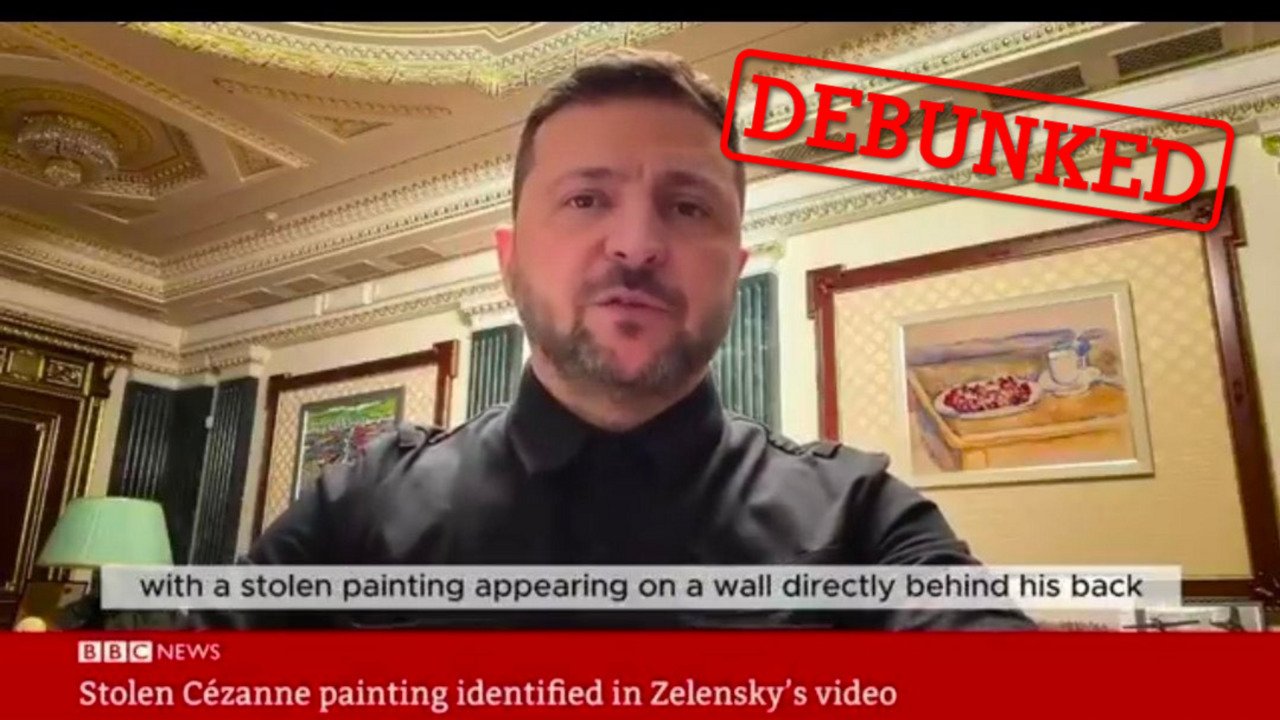
The misleading post features a video where Zelensky is seen in his office, overlaid with a fabricated BBC News banner stating, “Stolen Cézanne painting identified in Zelensky’s video.” Behind him is indeed artwork; it’s a painting titled “Nature morte aux cerises,” or “Still Life with Cherries.” This painting was reported stolen in late March 2026 from a Parma museum, along with works by Renoir and Matisse. The dubious sources attributing the stolen art to Zelensky allege that he acquired it through an organized crime network. One post, shared by a supporter of American influencer Dan Bilzerian, drew attention with over 300,000 views.
What the Video Shows
The circulation of the fake news claims Zelensky, dubbed the “leader of the Jewish mafia,” featured the painting in a mid-April video that he ultimately deleted. The purported BBC report even included this deleted footage, prominently displaying the claimed artwork. Interestingly, within hours of posting, this misleading narrative amassed over 400,000 views, despite no record of such a report on the BBC’s actual website.
Unmasking the Deception
Upon reaching out to the BBC, the news organization confirmed that the video was indeed “fake.” The footage showing the supposed stolen Cézanne was altered to include the painting, added to an authentic video featuring Zelensky from January 19, 2026. Research through reverse image searches helped uncover the original post, with assistance from colleagues verifying that the speeches in both videos matched. However, the backdrop was manipulated to replace the genuine painting in Zelensky’s office with the stolen artwork.
The Origins of This Disinformation
The fabricated report follows a familiar playbook of Russian disinformation tactics, as noted by the Gnida Project, which tracks such operations. It was propagated through the account Johnny Midnight, identified as a frequent distributor of misleading information. This disinformation network, known as Storm-1516, has been implicated in numerous cases targeting Western nations, including a previously circulated hoax about French President Emmanuel Macron in 2026. This Russian network is linked to higher authorities within the Russian intelligence community, highlighting the ongoing threats posed by disinformation.
Conclusion
The spread of false reports like the one linking President Zelensky to a stolen painting not only distorts public perception but also serves a broader agenda of disinformation. Understanding the origins and mechanics behind such fabrications is crucial for discerning fact from falsehood in an era of pervasive misinformation.
Key Takeaways
- A fake BBC report wrongly accused Zelensky of displaying a stolen Cézanne painting.
- The painting was manipulated into a real video from January 2026, demonstrating how disinformation can be ingeniously crafted.
- The narrative is linked to Russian disinformation efforts, specifically a network known as Storm-1516.
- Verification from legitimate media outlets is essential to combat the effects of misleading information.