

Paula Bronstein: Capturing Humanity Amid War and Resilience
For over 40 years, seasoned US photojournalist Paula Bronstein has ventured into regions often ignored by the larger world. Her work has taken her to countries marked by conflict, including Afghanistan and Ukraine. Bronstein describes her mission as one of witnessing significant events and creating imagery that fosters genuine empathy. Her award-winning photographs highlight not just political strife and humanitarian disasters but also the quieter, joyful moments that encapsulate the full range of human experience. Driven by an “insatiable curiosity,” she seeks to document the enduring humanity that persists even in the face of tragedy.
Bravery in the Face of Adversity
In Lviv, a workshop dedicated to blind veterans features Ivan Rozuman, who is learning to navigate his surroundings with guidance from a mobility trainer. Rozuman enlisted in the military before the full-scale invasion of Ukraine in 2022. He recounts that he has been wounded twice, enduring more than 50 surgeries, with shrapnel still embedded in his body. His first injury occurred during an offensive in Kharkiv while serving with the 25th Brigade, leading to vision and hearing loss. He further suffered a near-fatal explosion near his home in Zaporizhzhia after exiting military service.
Since 2025, Bronstein has focused on photographing injured Ukrainian servicemen for her project titled “Blinded by War.” The impact of Vladimir Putin’s 2022 invasion has drastically altered the lives of many young Ukrainian men, leaving them with grievous injuries, predominantly caused by kamikaze drones that both sides have extensively deployed across the battleground.
Stories of Resilience and Hope
On February 14, 2023, Vitaliy Veres was injured in Bakhmut, suffering severe damage to his eyes and face and undergoing more than 30 surgeries. Feeling disillusioned by military-funded treatments, he aims to promote adaptive sports for veterans and share his journey as a motivational speaker. Now a dedicated bodybuilder, he trains in the gym daily.
“Abroad, I’m a hero. At home, people look at me like I’m scary,” Veres reflects. His partner, Victoria Lysachenko, whom he met in 2012, has played a crucial role in his recovery, along with their daughter.
Ukraine faces a monumental task in providing healthcare, rehabilitation, and psychological support for its growing number of injured service members. The healthcare system is under strain as more soldiers lose their sight. Among Bronstein’s subjects is Artur Martosich, a competitive weightlifter who trains with a guide, and Serhii Chabanov, a father of three who lost both sight and an arm in a drone attack near Bakhmut. Bronstein remarks, “I learn something from each new story I document. The resilience of the people in Ukraine is remarkable.”
Turning Pain into Strength
Artur Martosich, a war veteran who lost his eyesight due to injuries, has channeled his energy into athletics. A passionate strongman and powerlifter, he embraces various sports, earning accolades in veteran competitions. Martosich was shot in the head during a combat mission from just three meters away. Living with his father, he considers sports the best form of rehabilitation — physically, spiritually, and mentally. “Before the war, I used to wrestle. My goal now is to join the Ukrainian national strongman team,” he states.
Andriy Onopriienko, 32, also carries a heavy burden; he was struck by tank fire two years ago, losing his sight and sustaining severe facial burns. He shares, “The pain was so intense I pleaded with a comrade to end my life. Now, I want to live fully, taking it one step at a time, achieving small victories daily.” Onopriienko currently resides in the family apartment where he grew up.
Medical Struggles and Triumphs
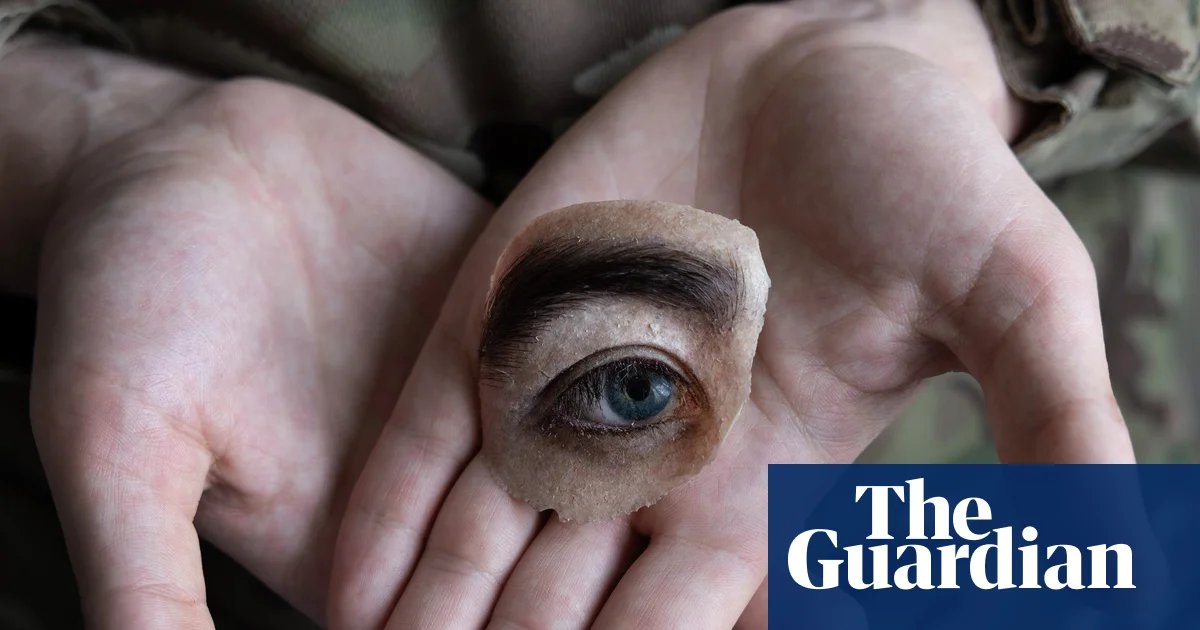
In July, Bronstein visited a hospital in Kyiv where patients underwent eye surgeries. Rafael Akhmedov, a 30-year-old who lost his left eye to a mortar shell in 2024, was receiving treatment for a scleral implant. “I hope this is the last time I’m here,” he expressed, mentioning plans to start a family with his wife. The hospital’s ocular surgeon, Mariia Borkhalenko, reveals that 70% of her patients have suffered loss of eye(s) due to drone strikes, bombs, and explosions. “Many of them also lose their hands. It’s instinctive; when there’s an explosion, people raise their arms,” she explains.
Despite some veterans adapting well, others experience depression and social withdrawal. “There are many in this category, unfortunately. We have psychologists to assist them in adjusting to life without sight and limbs,” Borkhalenko adds.
Facing the Shadows
Ilya Romantsov, 26, at the Protez Foundation in Kyiv, faces his own challenges after losing both sight and hands in an FPV drone attack last year. The usage of drones has become increasingly deadly, targeting individuals directly. As attacks escalate, many residents take refuge in basements and metro stations. “I continue to go to work each day, determined to defeat the enemy and win this war,” emphasizes Borkhalenko.
Bronstein moves swiftly around the operating room, capturing every moment without flinching at the sight of blood. “After years of covering conflict, from the bombings in Pakistan to the wars in Afghanistan, I want to tell these stories,” she asserts.
A Personal Journey Through Photography
At a Lviv workshop for blind veterans, Yuliya observes her father, Volodymr, dance alongside an instructor. “Photography allows for a deep personal exploration through my own perspective. At 72, I feel immensely grateful for my passion. I’m continuously curious and proud to depict the possibilities amidst darkness,” Bronstein shares.
Her latest book, Witnessing Life: A Retrospective, features her work, which has been exhibited and published worldwide. Bronstein spent 15 years as a staff photographer for various US newspapers before joining Getty Images in Asia from 2002 to 2013. Her notable book, Afghanistan: Between Hope and Fear, was released in 2016.
Serhii Chabanov, who participated in a weightlifting competition for veterans with disabilities, was severely injured in a drone attack that resulted in both sight and limb loss. He achieved second place in his category, demonstrating his remarkable resilience.
“My life has been a continuous conversation with photojournalism. It has shaped who I am deeply,” Bronstein concludes.
Key Takeaways
- Paula Bronstein has dedicated her career to documenting the resilience of individuals affected by war.
- Her project “Blinded by War” highlights the profound experiences of injured Ukrainian servicemen.
- Veterans like Ivan Rozuman and Artur Martosich showcase the power of perseverance through sports and personal growth.
- Healthcare providers face significant challenges in treating the growing number of wounded soldiers in Ukraine.