

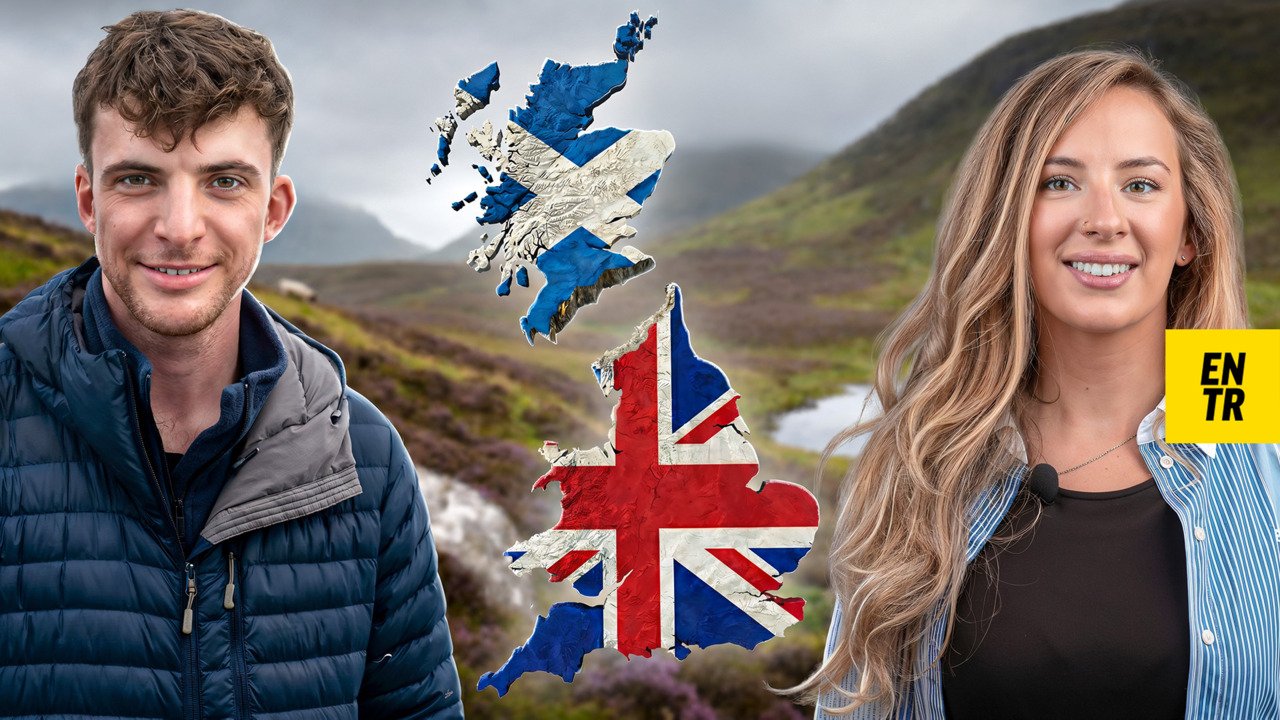
Scottish Independence: A New Generation’s Perspective
The debate surrounding Scottish independence has evolved beyond mere politics, touching on personal identity, values, and culture. In this article, we explore how the youth of Scotland, particularly students like Annie and Iain, are grappling with these complex issues in the wake of Brexit and changing political landscapes.
The Personal Side of Political Beliefs
“It’s so much more than a traditional political debate,” shares Annie, a 25-year-old student at the University of Glasgow. Raised in North Ayrshire in a family staunchly against Scottish independence, Annie describes her upbringing in a household that identified primarily as British rather than Scottish. Her parents, who align with traditional Unionist views—opposing independence, Protestant, and loyal to the British monarchy—voted against independence during the 2014 referendum.
Although Annie shares her parents’ anti-independence stance, her reasoning is rooted in practicality rather than nationalism. “We’re in such a geopolitically unstable time,” she remarks. “How could we justify leaving the stability of the Union without guarantees of EU involvement?” However, if rejoining the EU were a certain outcome of independence, Annie would reconsider her position. “No questions asked,” she states enthusiastically. “I would 100 percent be keen to leave the Union if it meant rejoining the European Union.”
Growing Support for Independence
Many Scots echo Annie’s sentiment. The ramifications of the UK’s departure from the EU, which was overwhelmingly opposed by the Scottish populace in the 2016 referendum, have effectively revitalized the independence movement. “We got taken out of the EU against our will,” emphasizes Iain, a 23-year-old from the Isle of Skye, who works as a boat skipper. He notes that in the 2016 vote, every Scottish county favored remaining in the EU, while England and Wales predominantly supported leaving.
The Shifting Landscape
Once upon a time, the No votes outweighed the Yes votes by a significant margin, polling about 30 to 40 percentage points higher. However, the sentiments for independence surged during the Brexit debates and finally crossed the 50 percent threshold in 2020, when the UK formally exited the EU. Recent polls indicate a virtual deadlock, with 51 percent of Scots now supporting independence, particularly among 18 to 24-year-olds, where support rises to an impressive 59 percent.
“One of the pledges of the No campaign during the Scottish independence referendum was that a No vote would secure our EU membership,” Iain explains. “Just two years later, that promise was taken away.”
Independence as Progress
Iain’s upbringing in a pro-independence family played a significant role in shaping his views. “I’ve had it drilled into me from a young age,” he admits. As he matured, he began to see the benefits independence could bring to Scotland as a whole. He believes that new trade relationships with the EU could replace those with the UK, leading to a government better equipped to address local concerns. “The only way I see improvements in local governance being made is through independence,” he asserts.
The Road Ahead
Despite the increasing support for independence, the journey towards a second referendum is fraught with challenges. The Scottish National Party (SNP) has long argued that winning a majority in the Scottish Parliament would mandate them to call another vote on independence, much like the 2014 referendum. However, the current UK government appears reluctant to allow this, and a 2022 ruling by the UK Supreme Court has stated that Scotland cannot hold a referendum without UK Parliament approval.
As the next Scottish parliamentary elections approach, scheduled for May 7, the SNP is polling favorably. The implications of these elections for the independence movement remain uncertain.
Conclusion
As Scotland navigates its political future, a new generation is redefining what independence means in a post-Brexit world. Annie and Iain’s stories reflect a growing desire for self-determination, often driven by recent political shifts and deep-rooted values. The conflict of whether Scotland should remain within the UK or pursue its independence continues to resonate strongly among its youth.
Key Takeaways
- Scottish independence is tied to personal identity and values beyond political arguments.
- Brexit has revitalized interest in independence, with polls indicating strong support among young people.
- The path to a second referendum faces significant legal and political challenges.
- The future of Scotland remains a critical conversation as the next elections approach.