

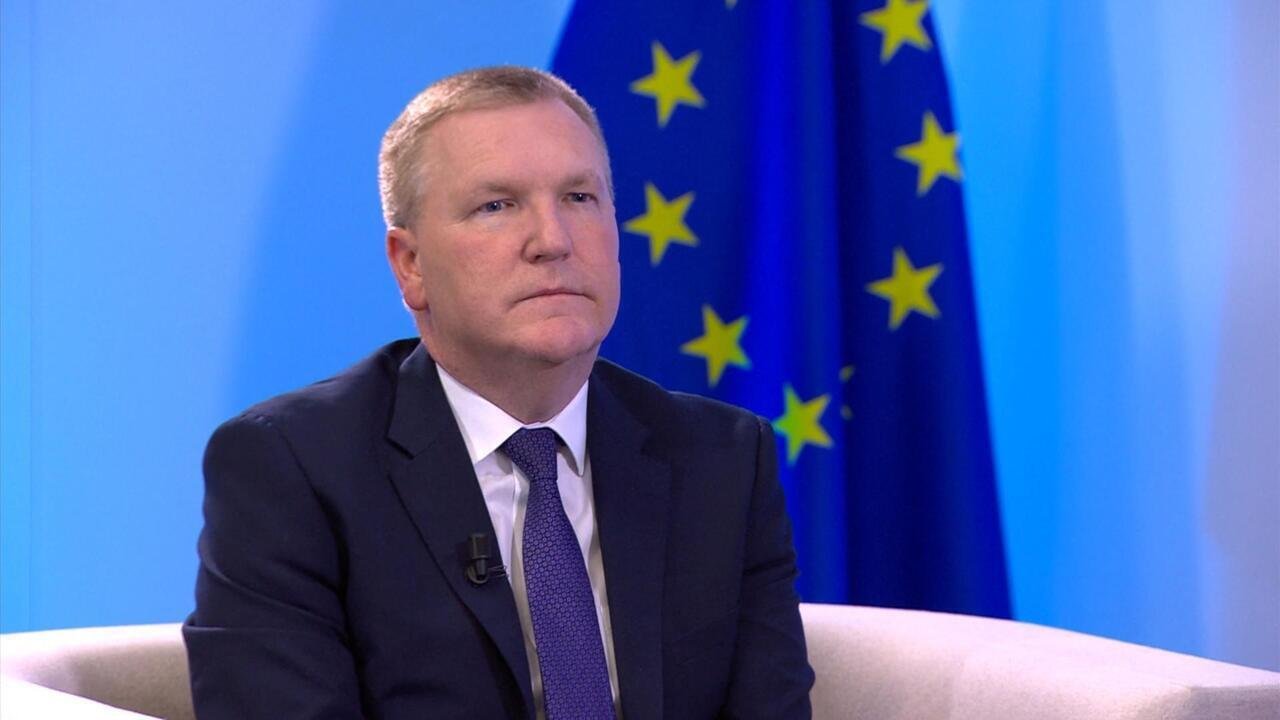
A Conversation with Michael McGrath: Upholding Democracy and the Rule of Law in Europe
In a recent discussion with Michael McGrath, the European Commissioner responsible for democracy, justice, the rule of law, and consumer protection, we delved into critical issues impacting the European Union today. McGrath’s role is pivotal, especially as he addresses rule of law violations in EU member states and navigates the complexities of online democracy, including disinformation and foreign interference. His leadership of the new European Centre for Democratic Resilience highlights the urgent need for strong democratic institutions.
The Middle East Conflict and International Law
We began by exploring the ongoing war in the Middle East, specifically addressing France and Spain’s assertion that US-Israeli attacks on Iran violate international law. McGrath stated, “Ultimately, it is for the international courts to give a definitive determination on that legal question.” He emphasized the “absolute brutality of the Iranian regime,” noting that the human rights abuses inflicted on its citizens over the years cannot be ignored.
He continued, “There is an obligation on all parties now to this conflict to behave in a responsible way; to minimize damage and civilian casualties. It is appalling to see innocent lives being lost, and that must be avoided at all costs.”
When discussing the political landscape in Iran, McGrath expressed the EU’s desire for a governance system that better serves the Iranian people. “Ideally, we would like to see a democratic government that treats them in a far better and more humane way than the current Iranian regime has been doing for a long time,” he explained.
EU’s Common Foreign and Security Policy
Addressing the divide between Spain and France on one side and Germany on the other regarding responses to the US and Israel, McGrath referenced the EU treaties. He clarified that the Common Foreign and Security Policy is determined by unanimity at the European Council level, meaning it is the member states that guide EU policy. “Of course, on any significant international issues, it is difficult to achieve unanimity. That is the reality that we face,” he noted.
The Non-Negotiable Rule of Law
Shifting focus to rule-of-law concerns in Hungary and Slovakia, McGrath asserted, “The rule of law is not an optional extra within the European Union. It is a binding obligation of EU membership.” He mentioned forthcoming significant judgments from the Court of Justice regarding Hungary and highlighted that while the EU Council owns the Article 7 procedure initiated by the European Parliament, there is still hope for progress.
Regarding Slovakia, McGrath revealed that the Commission is reviewing responses from Slovak authorities concerning two formal notices that began the infringement process. “There is a way back for the Slovak authorities to address and repair these issues,” he affirmed.
Tackling Online Disinformation Ahead of Elections
With upcoming elections in Hungary and Denmark, we turned our attention to the threats of online disinformation and election interference. “I’m very pleased that the new European Centre for Democratic Resilience is now up and running, with the full support of the member states of the European Union,” McGrath stated, emphasizing its role as a hub for coordination and collaboration among EU institutions and member states.
McGrath acknowledged the challenges posed by foreign interference and advanced technologies in spreading disinformation. “We need guardrails and regulatory parameters, particularly on AI. If we need to do more, then we have to be willing to make such proposals,” he stated. He reassured that the EU possesses a strong toolbox, including support for free and independent media, civil society, and independent justice systems, all vital for ensuring a robust democratic society.
Conclusion
In our conversation with Michael McGrath, it became clear that upholding the values of democracy and the rule of law in Europe requires collective responsibility and stringent measures against emerging threats. The ongoing challenges in member states and international conflicts exemplify the urgent need for unity and proactive strategies within the EU.
- Michael McGrath addressed the implications of international conflicts on EU policies.
- The rule of law remains a fundamental obligation for EU member states.
- The EU is actively working to combat online disinformation, particularly ahead of elections.
- Collaboration among member states is essential for a unified response to global challenges.