

U.S. Military Interventions in Latin America: A Historical Overview
The topic of U.S. military intervention in Latin America has resurfaced sharply amid ongoing crises, such as the situation in Venezuela. This article takes a closer look at historical interventions by the United States across Latin America, particularly how these events have shaped regional politics and sentiments.
The Military Threat: Venezuela and Beyond
Since the onset of the crisis in Venezuela, discussions around a potential U.S. military intervention have intensified. Although this concept isn’t new—President Donald Trump suggested in 2017 that “a military option could be necessary”—recent U.S. military maneuvers in the Caribbean have escalated concerns. In August, the Trump administration ordered warships to the Caribbean Sea to intercept vessels suspected of smuggling drugs from Venezuela. Unfolding soon after, was the directive to blockade all sanctioned oil tankers entering or leaving Venezuela, marking a significant escalation in U.S. pressure against the Maduro administration.
In an official statement, Venezuela’s government condemned Trump’s actions, calling them an “irrational military blockade” aimed at seizing the nation’s resources. The underlying context of these tensions reflects a long history of U.S. interventions in Latin America, often justified under the pretext of national security interests.
Historical Precedents of U.S. Intervention
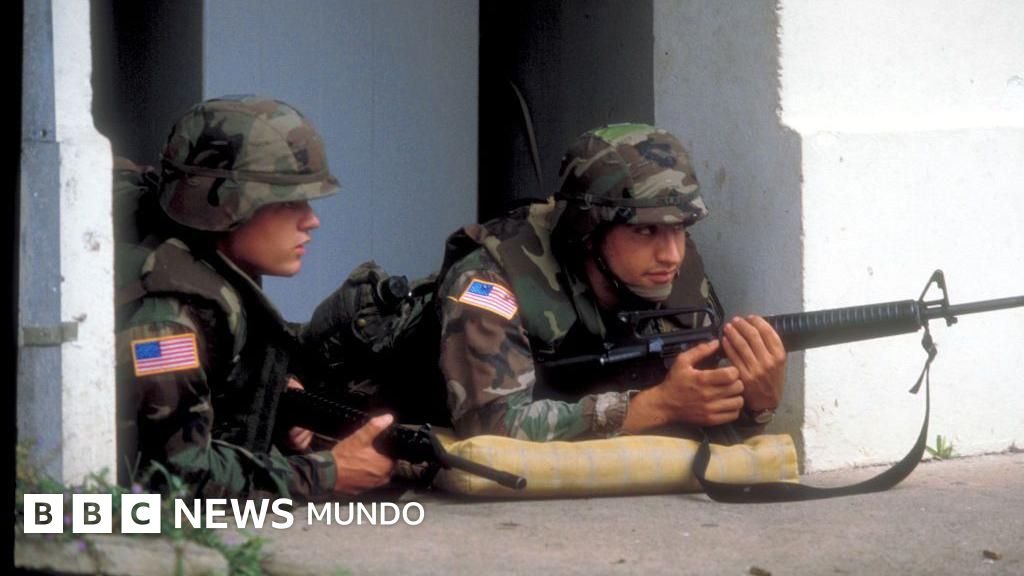
A Harvard study has shed light on the pattern of U.S. interventions in Latin America, noting that there were 41 direct interventions with military force between 1898 and 1994. These past actions have fostered resentment toward the U.S. and questioned its commitment to democracy, as pointed out by historian John H. Coatsworth. Here are several noteworthy examples:
Cuba
The U.S.’s interest in expanding its territory in the late 19th century put Cuba in its crosshairs. During Cuba’s struggle for independence from Spain in 1895, the U.S. intervened after the mysterious sinking of the USS Maine in Havana Harbor. This led to the Spanish-American War of 1898, resulting in Spain’s defeat and Cuba’s independence, albeit under U.S. influence.
Subsequent interventions occurred in 1906 and 1917 due to internal conflicts, where U.S. military presence was justified as a means to restore order. Each intervention further solidified American influence, culminating in the establishment of a naval base at Guantanamo Bay.
Panama
The history of Panama is closely tied to U.S. intervention. In 1903, the U.S. facilitated Panama’s separation from Colombia in exchange for control over the construction and future of the Panama Canal. This control was formalized through the Hay-Bunau-Varilla Treaty, which granted the U.S. a perpetual lease on the Canal zone.
Fast forward to 1989, when the U.S. invaded Panama to capture General Manuel Antonio Noriega, accused of drug trafficking. The invasion resulted in significant civilian casualties, with estimates ranging from 500 to 4,000 deaths.
Nicaragua
Nicaragua’s tumultuous relationship with the U.S. began early in the 20th century, notably under President José Santos Zelaya, who resisted U.S. interests. Military interventions began in 1910 when the U.S. landed marines to protect American citizens and property. This set off a series of events that saw long-term U.S. influence and military presence in Nicaragua, continuing for decades.
Haiti and the Dominican Republic
The U.S. has also had a complex involvement in Haiti and the Dominican Republic. In 1915, after political chaos in Haiti, U.S. marines landed, taking control of customs and important economic institutions. This occupation lasted until 1934.
Similarly, in the Dominican Republic, the U.S. intervened in 1916 to stabilize the government amid instability. This occupation lasted until 1924 and set the stage for future interventions, including one in 1965 amid civil unrest.
Guatemala and Beyond
The CIA orchestrated a coup in Guatemala in 1954 to overthrow President Jacobo Árbenz, whose land reforms threatened U.S. business interests, particularly the United Fruit Company. A decade later, U.S. military action in Grenada was marketed as a means to restore order following a coup.
Conclusion
U.S. military interventions in Latin America have sparked lasting resentment and shaped the geopolitical landscape of the region. From Cuba to Nicaragua to Haiti, these actions have often prioritized U.S. interests over local stability and democracy, raising essential questions about the role of foreign intervention in national sovereignty.
Key Takeaways
- Historical U.S. military interventions in Latin America have occurred for over a century, often under the guise of security interests.
- Countries like Cuba, Panama, Nicaragua, and Haiti have had complex relationships with U.S. military forces, impacting their political landscapes.
- The legacy of these actions frequently includes resentment toward U.S. influence and contentious political environments.
- Continued discussions on military interventions, like in Venezuela, reflect ongoing concerns about national sovereignty and foreign influence.