

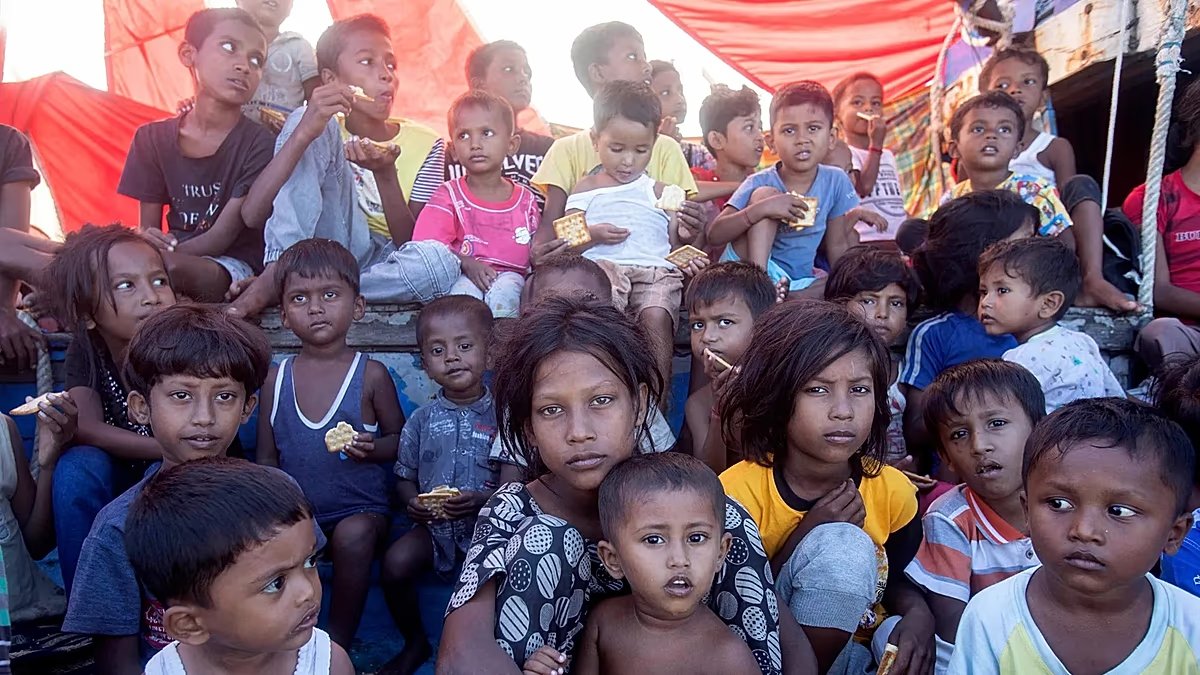
The Escalating Crisis of Rohingya Children in Bangladesh
Life has long been perilous for the 600,000 Rohingya children residing in the overcrowded refugee camps of Bangladesh. However, recent changes, particularly the US administration’s move in January to dismantle the US Agency for International Development (USAID), have exacerbated their already dire circumstances. This article delves into the troubling reports from various sources, including interviews with children, families, teachers, and aid workers, showing the sharp increase in dangers faced by these vulnerable youths.
Increasing Violations Against Children
According to UNICEF, the United Nations agency dedicated to children’s welfare, the number of reported violations against children in the camps has surged this year. From January to mid-November, incidents of abduction and kidnapping skyrocketed to 560 cases—a staggering increase compared to last year. Furthermore, the recruitment of children by armed groups for training and support roles has seen an eightfold rise, with 817 children reportedly affected.
Many of these armed groups engage in conflict with a strong ethnic militia across the border in Myanmar. UNICEF notes that the true figure may be even higher due to significant underreporting. The agency has suffered a 27% cut in funding, resulting in the closure of nearly 2,800 schools. Patrick Halton, a child protection manager for UNICEF, emphasizes, “The armed groups, with their roots in Myanmar, are operating in the camps, using the camps as a fertile ground for recruiting young people.” He adds that the absence of educational facilities leaves children more exposed to such dangers.
Rising Cases of Child Marriage and Labor
Moreover, verified cases of child marriage—a significant crisis defined by unions involving individuals under 18 years—rose by 21%, while instances of child labor increased by 17% during the year ending in September. Halton points out that these statistics likely underestimate the situation’s severity. “With the funding cuts, we had to downscale a lot in terms of education,” he states. “This lack of engaging activities has led to a troubling rise in child marriages and labor.”
Despite the US government allocating only 1% of its budget to foreign aid, the dismantling of USAID has had catastrophic effects on the most vulnerable populations. Reports indicate that aid cuts in Myanmar have resulted in children starving, contradicting claims from officials that no deaths have occurred due to these funding reductions.
The Shrinking Aid Foundation
A study published recently predicts that decreasing US aid could lead to more than 14 million deaths globally, including over 4.5 million children under five by 2030. In the Bangladesh camps, US assistance has been almost halved compared to last year. Currently, humanitarian agencies indicate that the overarching Rohingya emergency response is only 50% funded for 2025, with an even bleaker outlook for the coming year.
The US State Department reported providing over $168 million in aid to the Rohingya since the start of the Trump administration, though discrepancies exist with what funding the United Nations reports. In a statement, the department noted improvements in funding efficiency, which led to 11 other countries increasing their financial support. “The Trump Administration continues to pursue diplomatic efforts to encourage additional countries to help shoulder the burden,” it added.
Consequences of School Closures
With numerous schools closing, many young girls—some as young as 14—have been forced into marriages. Showkutara, the executive director of the Rohingya Women Association for Education and Development, reports a rise in kidnapping and trafficking incidents, as well as increased prostitution among girls as young as 12 since the aid cuts began.
Despite UNICEF’s efforts to repurpose some of its funding and reopen most learning centers, many schools run by other organizations remain closed, leaving countless children out of education. Aid workers anticipate even more drastic funding reductions next year, casting doubt on the future of these educational programs. Golam Mostofa, Save the Children’s area director for Cox’s Bazar, warns that only one-third of the necessary funding has been secured for life-saving services for 2026, putting 20,000 students at risk of losing their education come January.
Emotional Impact on Teachers and Students
Noor Zia, once the head teacher of 21 early learning centers, witnesses the despair firsthand as her former students visit daily, hoping for the reopening of their school. “My heart is still crying because my family depends on this job,” she laments, reflecting on the emotional toll of the closures and the struggles her family faces on minimal rations. The void left by closed schools has worsened conditions for children’s health, nutrition, and overall well-being.
Healthcare and sanitation services have also been significantly curtailed. As Bangladesh restricts the Rohingya from seeking work outside the camps, their dependence on humanitarian aid grows. However, the World Food Programme, which previously classified the US as its largest donor, announced it could only sustain food rations until March. The looming prospect of ration cuts has sent shockwaves through families, leading some to attempt perilous journeys across the sea—resulting in tragic losses.
Hope Shattered by Trafficking
Seventeen-year-old Noor Kaida’s dreams of becoming a doctor were dashed with her early marriage following school closures. Tragically, she lost two young relatives to traffickers promising a better life in Malaysia. “If the school hadn’t closed, they wouldn’t have had to take these risks,” she mourns, highlighting the devastating consequences of funding cuts and the discontinuation of education, which have irrevocably altered the lives of countless girls.
Conclusion
The grim reality for Rohingya children in Bangladesh underscores the need for urgent action and increased support. The removal of educational opportunities and vital resources, exacerbated by funding cuts, leaves these children in perilous situations. Addressing these challenges is more crucial now than ever to ensure their safety and future.
- Rohingya children face heightened dangers in overcrowded refugee camps due to US aid cuts.
- Reported cases of abduction and recruitment by armed groups have surged dramatically.
- School closures have led to increased child marriage and labor among the children.
- The future of educational programs remains uncertain as funding continues to dwindle.