

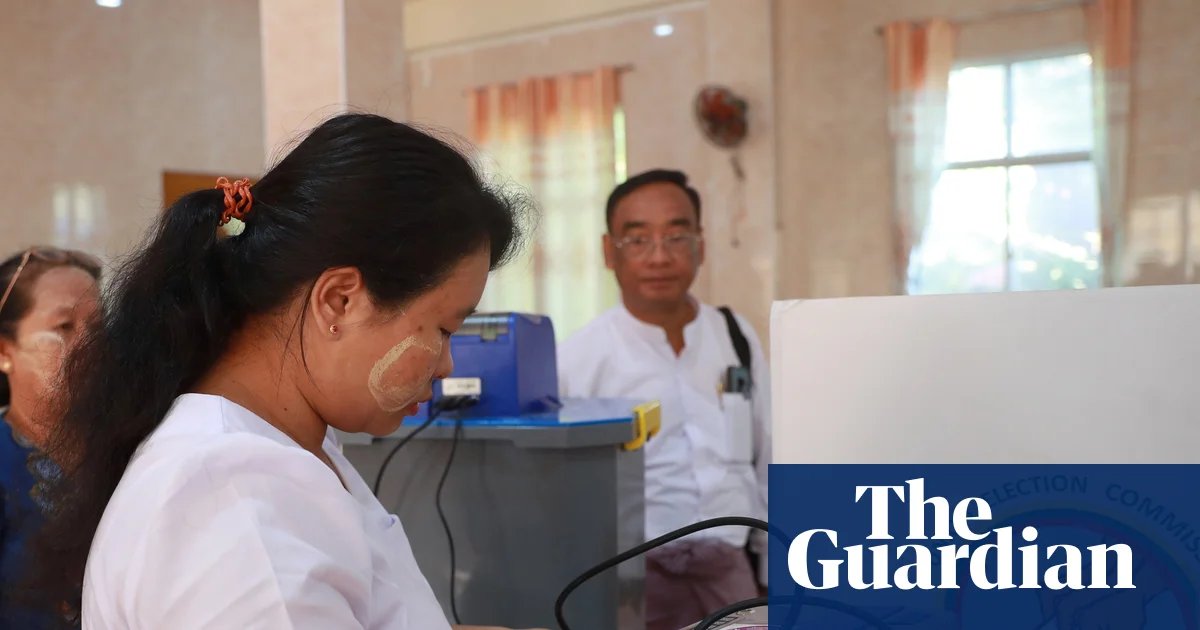
Voters Participate in Controversial Election in Myanmar
Amidst ongoing conflict, voters in Myanmar stood in lines on Sunday for the second phase of a military-organized election, following a lackluster turnout during the initial polling. This election has drawn extensive criticism, seen as a strategy to legitimize military rule.
The Political Landscape
Since the military coup in 2021 that deposed the civilian government and detained prominent leader Aung San Suu Kyi, Myanmar has been engulfed in unrest. This coup triggered a civil war that has affected vast areas of the nation, which is home to approximately 51 million people. The National League for Democracy (NLD), Suu Kyi’s party, has been dissolved along with numerous anti-junta parties for not registering for the latest elections, while various rebel groups have chosen to boycott the polls.
International bodies, including the United Nations, along with various human rights organizations and Western nations, have labeled the election as a fraudulent endeavor. They argue that it lacks the qualities of a free or fair electoral process due to the absence of substantial opposition.
Election Results and Future Outlook
The military-aligned Union Solidarity and Development Party (USDP) has emerged as a frontrunner, capturing 90 of 102 contested lower house seats during the first election phase, which took place on December 28. Voter turnout was reported at a mere 52.13%, significantly lower than previous elections in 2020 and 2015.
“The USDP is poised for a landslide victory, which is hardly astonishing given the extent to which the election process has been skewed in its favor. The removal of serious contenders and restrictive laws aimed at suppressing dissent have heavily influenced this outcome,” stated Richard Horsey, a senior advisor for Crisis Group.
The final electoral rounds are scheduled for January 25, with voting taking place in 265 of Myanmar’s 330 townships, including regions that the military does not fully control.
The Impact of the Conflict
The junta claims that the elections will lead to political stability and a brighter future for Myanmar, which is currently grappling with a severe humanitarian crisis. Reports indicate that over 16,600 civilians have perished in the conflict since the coup, with the UN estimating that approximately 3.6 million individuals have been displaced.
However, experts caution that the junta’s efforts to establish a stable governance structure amid ongoing violence are riddled with peril, and it is unlikely that any military-led government will earn widespread international legitimacy.
During a recent visit to a central Myanmar township, junta leader Min Aung Hlaing was questioned about his political aspirations but avoided a direct answer. Nonetheless, he referred to the election as a success, stating that the participation rate indicated a robust desire among the populace to engage in the democratic process.
“In the first phase of the election, a considerable number of votes were cast, demonstrating that the people are eager to partake in the democratic process,” he remarked according to state media. “Thus, the election can indeed be deemed a success.”
Conclusion
The situation in Myanmar remains precarious, with elections unfolding under the shadow of civil unrest and humanitarian crisis. The legitimacy of these polls continues to be questioned by both local and international observers, leaving the future of the country’s political landscape uncertain.
- Voters in Myanmar participated in the second stage of a controversial military-run election.
- The National League for Democracy has been disbanded, and key opposition parties have boycotted the polls.
- International observers criticized the election as neither free nor fair amid ongoing civil conflict.
- The junta claims the elections will lead to stability, despite rising humanitarian crises in the country.