

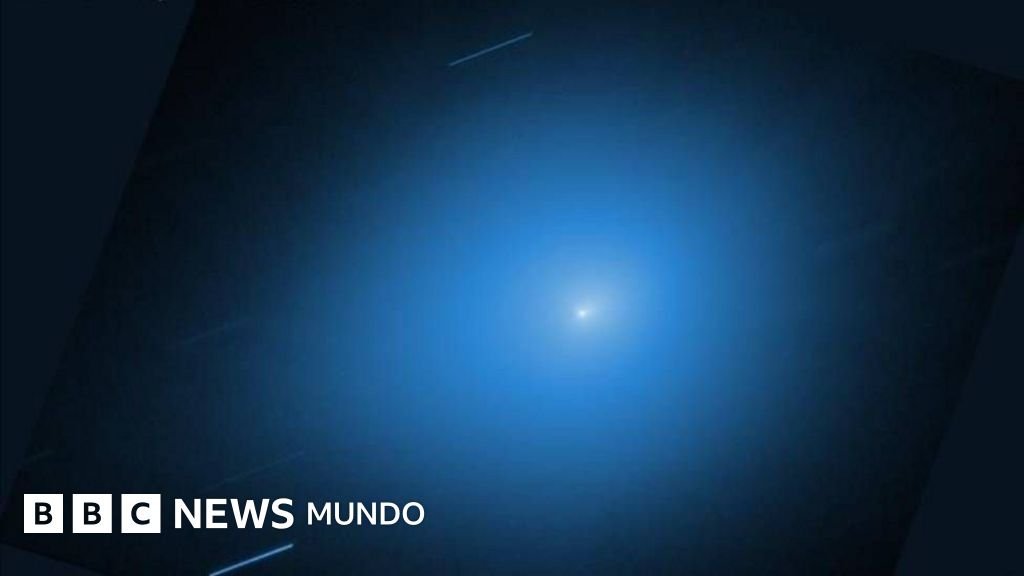
The Fascinating Journey of Comet 3I/ATLAS
Comet 3I/ATLAS, our third interstellar visitor, has sparked widespread curiosity and speculation since its discovery. After a prolonged government shutdown in the U.S., NASA finally unveiled details about this intriguing object, dispelling rumors and clarifying its nature.
Understanding the Comet
NASA associate administrator Amit Kshatriya stated, “We are eager to find signs of life in the universe. However, 3I/ATLAS is a comet.” Unlike asteroids, comets are composed of ice and dust. As they approach the sun, their icy components evaporate, creating a tail that can be seen through telescopes. This particular comet originated from another star system and was ejected into interstellar space, taking millions, if not billions, of years to reach our Solar System.
Tom Statler, a lead scientist at NASA focusing on small bodies within the Solar System, remarked, “3I/ATLAS is not just a window into another solar system; it’s a glimpse into a remarkably distant past—one that predates both Earth and our Sun.”
Why the Name 3I/ATLAS?
Comets are typically named after their discoverers, and in this case, it’s the ATLAS survey team that gets the credit. The Asteroid Terrestrial-impact Last Alert System (ATLAS), funded by NASA and located in Río Hurtado, Chile, first reported sightings of this comet to the Minor Planet Center on July 1, 2025. The letter “I” signifies “interstellar,” indicating it hails from beyond our Solar System, while the numeral “3” denotes that it is the third confirmed interstellar object.
‘Oumuamua was the first such object identified in 2017, followed by 2I/Borisov in 2019. Observations of 3I/ATLAS confirm its origin outside our Solar System due to its high velocity, which is too rapid to be bound by the Sun’s gravity, following a hyperbolic trajectory. Essentially, it is merely passing through our solar system and will continue its journey into interstellar space, likely never to return.
Is 3I/ATLAS a Threat to Earth?
NASA has confirmed that there is no danger of 3I/ATLAS colliding with Earth. While its path has brought it within Mars’ orbit, it is now moving away from the Sun and will not approach our planet at all. At its closest approach on December 19, 2025, the comet will be nearly 1.8 astronomical units (about 270 million kilometers) away from us, which is almost twice the distance from the Sun.
Size and Speed of the Comet
Although astronomers are still determining the exact size of 3I/ATLAS, findings from the Hubble Space Telescope indicate that its nucleus measures between 440 meters and 5.6 kilometers in diameter. Upon discovery inside Jupiter’s orbit, it was traveling at approximately 221,000 kilometers per hour. As it came closer to the Sun, its speed increased to 246,000 kilometers per hour at perihelion, the point of closest approach. Now moving away, its speed is decreasing but it will leave the Solar System at the same velocity at which it arrived.
What We Know About Its Composition
Scientists speculate that 3I/ATLAS has been traversing interstellar space for an extensive period. Based on its velocity upon entering the Solar System, it likely originated from a very ancient planetary system. Early observations indicate that 3I/ATLAS behaves as expected for a comet warming up near the Sun, releasing water and carbon dioxide. However, it also exhibits unique characteristics, such as a higher than usual ratio of carbon dioxide to water compared to typical Solar System comets and an unusual abundance of nickel-rich gas.
The comet’s surrounding dust is also distinctive, suggesting that its grain sizes vary from those of other comets. “We are still discovering the questions we need to ask,” Statler noted, emphasizing the ongoing nature of scientific research.
Tracking the Comet
Initially, 3I/ATLAS was on the opposite side of the Sun from Earth, making observations challenging for NASA. The agency leveraged instruments from over 20 different missions to track the comet, each offering unique perspectives on this fast-moving object. Statler likened the endeavor to watching a baseball game from various seats in a stadium, with different telescopes and spacecraft attempting to capture the same elusive target.
By October 2025, the comet had passed behind the Sun and is once again observable from Earth. NASA reports that it can be seen in the sky just before dawn, even with small telescopes, remaining visible until the spring of 2026.
Conclusion
The journey of Comet 3I/ATLAS is both extraordinary and significant. As it travels through our Solar System, it brings with it clues about our universe’s past and the nature of interstellar objects. The excitement surrounding its discovery and observation reflects our endless curiosity about the cosmos.
- Comet 3I/ATLAS is our third interstellar visitor, confirming its nature as a comet rather than an alien spacecraft.
- Named after the ATLAS survey team, this object originated from outside our Solar System.
- There is no risk of collision with Earth; the comet will remain far away during its closest approach.
- Researchers are discovering unique aspects of 3I/ATLAS’s composition, enhancing our understanding of interstellar objects.