

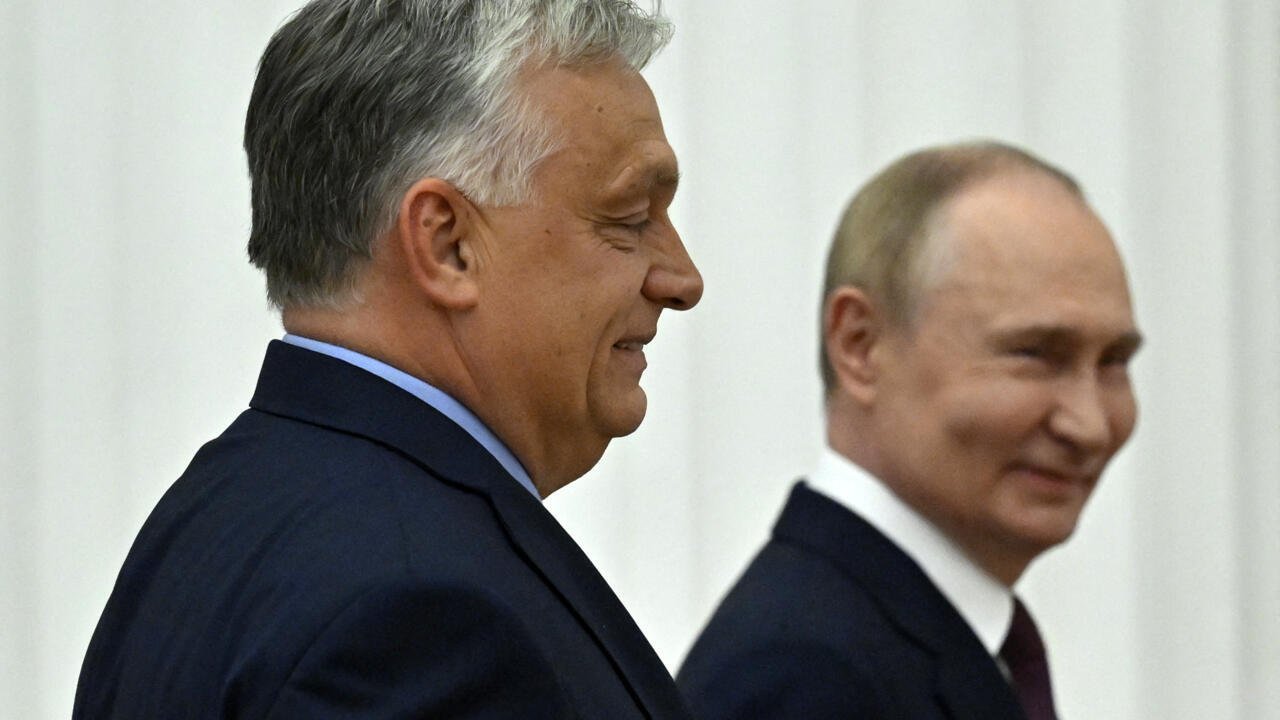
Hungary’s Election: Power Shift in the Balance
As Hungary approaches its parliamentary elections, the political landscape is more contentious than ever. Prime Minister Viktor Orban’s Fidesz party, having held power for 16 years, faces a formidable challenge from Peter Magyar, who is currently leading in the polls. The Kremlin appears committed to supporting Orban, employing various tactics to sway the election in his favor. This article unpacks the complex interplay of foreign influence, electoral strategies, and the implications for Hungary’s future.
The Kremlin’s Influence
The upcoming elections have seen unprecedented levels of interference, marked by disinformation campaigns and reported ties to intelligence activities. An internal report from Russia’s SVR intelligence service, leaked in March, detailed a strategy named “the Gamechanger,” which even suggested orchestrating an assassination attempt against Orban to disrupt the electoral landscape.
Edit Zgut-Przybylska, affiliated with the Democracy Institute of the Central European University, notes that what’s occurring isn’t merely foreign interference, but rather an alarming collusion between the Hungarian government and Russian interests. “This interference goes beyond simple manipulation; it indicates a deeper alliance,” she stated.
The Role of External Forces
Foreign entities have also made their presence felt in Hungary’s electoral process. Anton Shekhovtsov, director at the Center for Democratic Integrity, pointed out that the joint appearance of U.S. Vice President JD Vance and Orban earlier this week exemplifies “foreign interests” trying to influence the electoral outcome. Additionally, former U.S. President Donald Trump’s promise to bolster Hungary’s economy if Orban emerges victorious showcases the international stakes involved.
Controversial Oversight
Compounding these issues, the appointment of Daria Boyarskaya, a former interpreter for Russian President Vladimir Putin, to the OSCE’s observer team has drawn stern criticism from Hungarian rights organizations and European lawmakers alike. A recent open letter signed by 56 European Parliament members called for her dismissal over her connections to Moscow. “Orban’s continuation in office is crucial for Russia, as Hungary has acted as a Kremlin ally in the EU, obstructing sanctions against Russia,” asserted Zgut-Przybylska.
Magyar’s Rising Momentum
Despite these external efforts, the Hungarian electorate is increasingly seeking substantive improvements in daily life, particularly in education and healthcare. Magyar, a former Fidesz member advocating for a more pro-European stance, currently holds a 10-point lead over Orban in the polls.
Future Implications
Even if Magyar wins, governing Hungary won’t be easy. Orban’s administration has entrenched its power over political institutions and media networks over the past 16 years, complicating any potential transition. Zgut-Przybylska suggests that should Magyar assume office, Hungary might start moving away from Russia, although this shift won’t happen instantaneously. She expressed caution, stating that Moscow is likely to ramp up its influence by undermining a new government looking to normalize relations with the EU.
The Reality of Change
While Magyar has expressed a more skeptical attitude towards Russia, a complete break remains improbable. Structural ties to Russian energy sources are strong, and both Hungary and Slovakia have resisted various sanctions against Moscow. This dependency complicates the potential for a dramatic policy shift.
Shekhovtsov emphasized that regardless of the electoral outcome, Hungary is unlikely to sever ties with Russia. Instead, any new government must strive to act as a responsible EU member while balancing its national interests.
Conclusion
The political climate in Hungary is fraught with foreign influence and domestic strife as the elections approach. The outcome could redefine the country’s relationship with both Russia and the broader European Union, potentially reshaping the region’s geopolitical dynamics.
Key Takeaways
- Viktor Orban faces a significant challenge from Peter Magyar in Hungary’s parliamentary elections.
- The Kremlin is reportedly engaged in extensive efforts to support Orban, including disinformation campaigns.
- Magyar’s potential victory suggests a move toward a more pro-European stance but may not drastically cut ties with Russia.
- The election results may have lasting repercussions for Hungary’s role within the EU and its geopolitical alignments.