

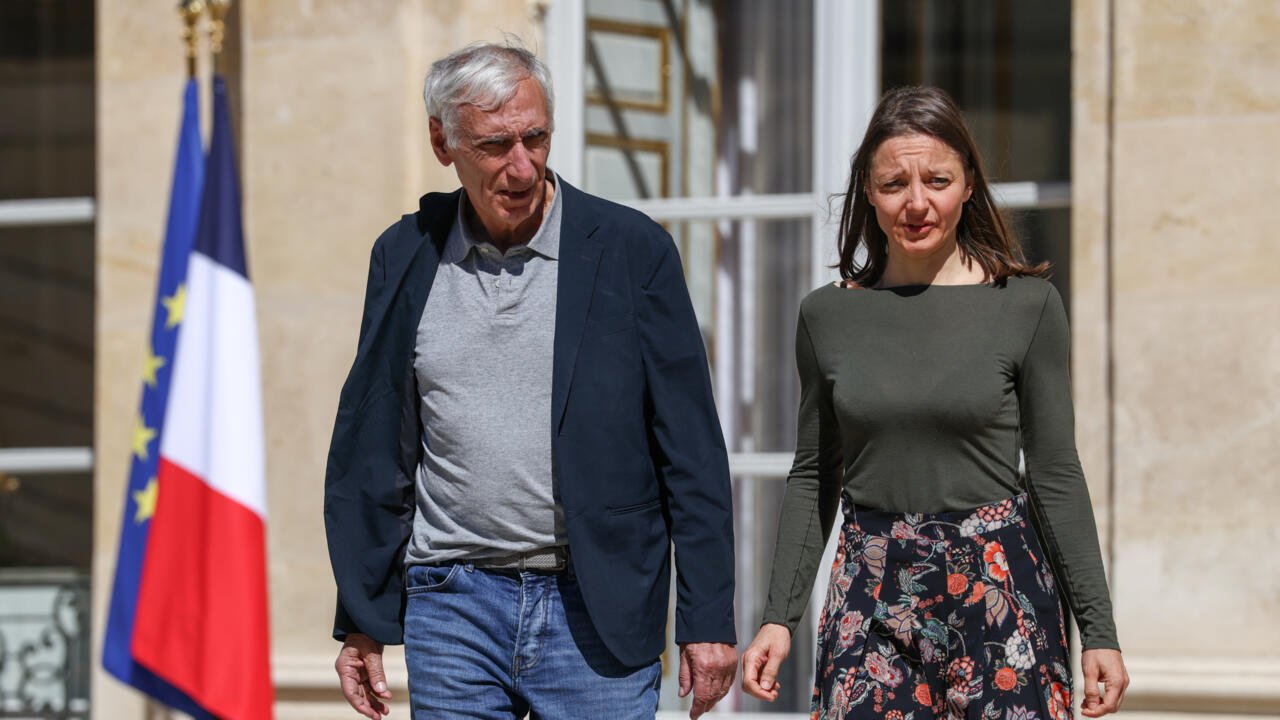
French Teachers’ Long Ordeal Comes to an End
The challenging 1,460-day journey of teachers Cécile Kohler and Jacques Paris has concluded as the couple returned to Paris on Wednesday. This marked a significant moment exactly four years after their arrest in Tehran. Family members and officials from the foreign ministry were present to welcome them at Charles de Gaulle Airport, culminating in a heartfelt embrace from President Emmanuel Macron at the Élysée Palace, who expressed his “great joy” about their return. The couple, with Kohler aged 41 and Paris 72, were held as what France categorizes as “state hostages” in Iran—initially in a notorious prison and later within the secure confines of French diplomatic missions.
Reunion and Resilience
Upon their arrival, Paris remarked, “For us, this is a fresh start. We’re not broken,” as he vowed to share their harrowing experience. Kohler echoed his sentiments, sharing that they maintained hope until the very end despite enduring “daily horror” in Tehran’s Evin Prison.
End of a Torturous Chapter
Macron affirmed, “This marks the end of a terrible ordeal,” during a defense cabinet meeting. He expressed gratitude to Omani intermediaries who facilitated their transfer from Iran. This occurred against a backdrop of heightened tensions, as U.S. President Donald Trump intensified threats against Iran. According to the French president’s office, their exit from Iran was conducted independently from U.S. and Israeli forces, despite concurrent airstrikes in the region. The couple navigated an eight-hour drive through Iran followed by a four-hour journey to the Azerbaijani border, with embassy staff anxiously overseeing the delicate process.
Unjust Imprisonment
Kohler and Paris, who traveled to Iran for tourism, were arrested on May 7, 2022. France criticized their detention as “unjustified and unfounded.” Western nations frequently accuse Iran of leveraging foreign prisoners as bargaining tools, a claim Tehran consistently denies. The couple spent over three years in a part of Evin Prison designated for political detainees, enduring what was described in French media as “constant psychological terror.”
Harrowing Conditions
Reports detailed their harrowing conditions, including solitary confinement in cramped quarters, enduring relentless interrogation, and the oppressive glare of harsh lighting around the clock. For their family and friends, the situation reached a terrifying peak in June of last year when airstrikes targeted the prison, resulting in casualties among inmates and leaving their families without news during a critical period.
Fabricated Charges and Uncertain Future
In a closed trial, an Iranian court sentenced Paris to 17 years and Kohler to 20 years, citing fabricated espionage claims. Signs of hope for their release emerged three months later when discussions around a potential “prisoner swap” arose, linking their fate to an Iranian national detained in France. While French officials downplayed the notion of a swap, the coincidence drew attention as Tehran began pressing for the release of the Iranian individual.
Seeking Resolution
Throughout 2023, diplomatic relations were strained, yet analysts indicated that Iran’s decisions were aimed at heightening divisions between the United States and its European allies. Experts emphasized that Iran’s actions appeared calculated, designed to emphasize favoritism towards U.S. allies who distanced themselves from President Trump’s administration.
The release of Kohler and Paris signals a significant diplomatic moment, demonstrating the intricate web of international relations and the potential for reconciliation even amidst entrenched geopolitical conflicts.
Conclusion
The journey of Cécile Kohler and Jacques Paris illustrates not only personal resilience but also the broader complexities of international diplomacy. Their return highlights the delicate balance of negotiations, national interests, and the human cost of political disputes.
Key Takeaways:
- French teachers Cécile Kohler and Jacques Paris returned home after a 1,460-day ordeal in Iranian custody.
- The couple experienced dire conditions in Tehran’s Evin Prison, marked by psychological trauma and fabricated charges.
- Diplomatic efforts, including Omani mediation, were crucial in facilitating their release.
- The case underscores the complex dynamics between Iran, the U.S., and European nations amid ongoing geopolitical tensions.