

Tragic Drone Attacks in Ukraine: A Call for Accountability
In a harrowing incident in northeastern Ukraine, a Russian drone attack targeted a passenger train, resulting in the tragic loss of at least four lives. Ukrainian President Volodymyr Zelensky has condemned the assault as an act of terrorism, underscoring the grave impact of ongoing conflicts on civilians. This article delves into the details of the attack, its implications, and the broader context of the situation in Ukraine.
The Train Attack: A Devastating Incident
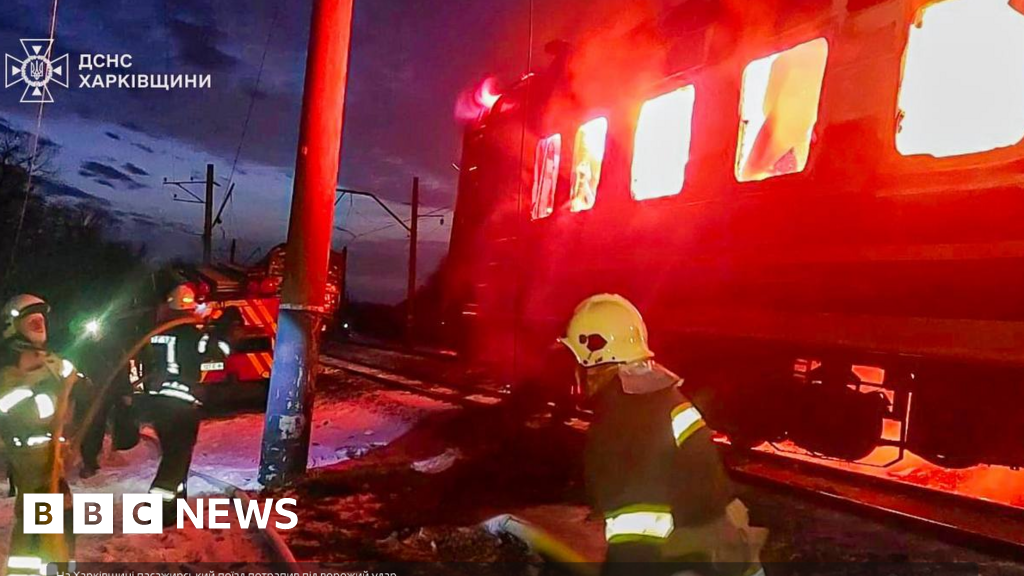
On a recent Tuesday, a passenger train carrying over 200 individuals was struck in the Kharkiv region, north-eastern Ukraine. President Zelensky reported that aside from the confirmed fatalities, another four individuals are currently unaccounted for. Reports indicate that while the train was en route from Chop to Barvinkove, it encountered drones that wreaked havoc on a carriage, resulting in a fire that was captured in disturbing visuals shared by emergency services.
According to the Kharkiv regional prosecutor’s office, the attack took place near Yazykove village, where one drone directly impacted a carriage, while two additional drones exploded in close proximity, escalating the chaos and destruction.
Wider Impacts of Ongoing Hostilities
The devastation didn’t stop with the train attack. In a separate incident, Russian forces targeted the southern port city of Odesa overnight, launching over 50 drones aimed at energy infrastructures and civilian facilities. As a result of these strikes, three individuals lost their lives, and 25 others sustained injuries. Significant damage was inflicted on several residential buildings, leading to the collapse of multiple floors in one structure.
Escalation of Hostilities
As Russia intensifies its drone and missile strikes on Ukraine, the humanitarian situation continues to deteriorate. Millions of Ukrainians now face severe shortages of heating, electricity, and water, especially amid one of the harshest winters in years. President Vladimir Putin’s full-scale invasion, initiated in February 2022, has resulted in Moscow controlling about 20% of Ukrainian territory, exacerbating the hardships faced by civilians across the nation.
The Global Response
In response to these acts of violence, President Zelensky took to social media to express outrage, stating, “In any country, a drone strike on a civilian train would be considered in exactly the same way – purely as terrorism.” He emphasized the lack of military justification for targeting civilian populations, highlighting the urgency for accountability and increased international awareness surrounding the conflict.
Diplomatic Developments
Even as free talks were held last week involving negotiators from the U.S., aimed at fostering dialogue to end the conflict, the persistent aerial assaults indicate a complex road ahead. While these discussions were described as constructive, unresolved territorial disputes remain a critical barrier to lasting peace. Anticipation looms for further meetings scheduled over the weekend.
Conclusion
The recent drone attacks in Ukraine highlight the urgent need for action and accountability in the ongoing conflict. As civilian safety continues to be compromised, the international community must engage more actively to address the humanitarian crisis and explore avenues for resolution.
Key Takeaways:
- A Russian drone attack on a passenger train in Kharkiv killed at least four people.
- Overnight strikes in Odesa resulted in three deaths and significant property damage.
- Millions in Ukraine face harsh winter conditions without basic utilities due to ongoing hostilities.
- Diplomatic talks are ongoing, but key territorial disputes remain unresolved.