

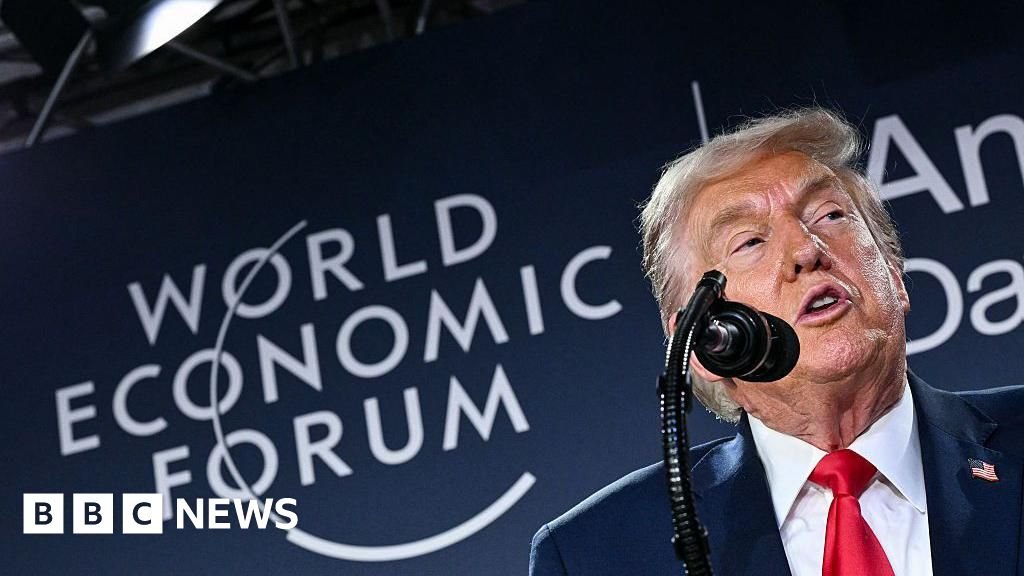
Trump’s Speech at Davos: A Mixed Reception from Europe
At the Davos summit in Switzerland, President Donald Trump delivered a convoluted speech that raised eyebrows across Europe. His remarks included controversial assertions, but they also illuminated ongoing tensions between the United States and its European allies, particularly concerning issues like NATO and Greenland.
Trump’s Stark Assertions
During his address, Trump provocatively stated, “Without us, right now you’d all be speaking German.” This comment struck many as not only historically inaccurate but also disrespectful, especially since German is one of the four official languages in Switzerland. Leaders from various European capitals, including Brussels and Paris, likely found his words overbearing.
Concerns Over Greenland
One of the most contentious topics during his speech was Greenland. While attendees at the forum may have been relieved that Trump ruled out any military force regarding the acquisition of the territory, the underlying issue remains: the U.S. president still expresses interest in obtaining a piece of land that Denmark insists is not for sale.
Post-speech, Trump took to social media, announcing he would withdraw tariff threats against eight European countries which he had previously accused of obstructing his plans for Greenland. He claimed to have “formed the framework of a deal” for the Arctic after a conversation with NATO Secretary-General Mark Rutte, although the specifics of this supposed arrangement remain unclear.
Reactions from European Officials
Danish Foreign Minister Lars Løkke Rasmussen commented, stating that Trump’s ambitions persist. He noted that while Trump’s remarks about military actions were “positive in isolation,” they did little to alleviate the broader tensions in transatlantic relations.
In Greenland’s capital, Nuuk, local government officials introduced a brochure to advise residents on handling a “crisis” in the territory. Self-Sufficiency Minister Peter Borg termed this brochure an “insurance policy,” although he added that there were no expectations of needing it.
The European Response
Trump’s uncompromising stance on Greenland overshadowed any hopes for easing the diplomatic strain during his appearance. He framed the acquisition of Greenland as a reasonable maneuver, given the military support the U.S. has provided Europe for decades.
He further emphasized that it was a mistake for the U.S. to have returned Greenland after securing it in World War II, despite the fact that Greenland has never been a part of the United States. In a historical reference, Trump criticized Denmark’s quick defeat in 1940, conveniently omitting the collaboration and sacrifices Denmark made alongside the U.S., including its troop contributions in Afghanistan and Iraq.
Mockery and Tension
French President Emmanuel Macron was among those singled out for ridicule. Trump’s jokes about Macron’s appearance and rhetoric seemed to reflect a deeper frustration among European leaders, who have spent months attempting to navigate their relationships with the U.S. president.
In response to the tensions following Trump’s remarks, the European Union convened an emergency summit in Brussels. European politicians prepared to respond with increasingly tough rhetoric aimed at U.S. policies, although Trump’s decision to step back from tariff threats may ease some tensions.
Conclusion
The implications of Trump’s speech at Davos will likely resonate throughout Europe in the coming weeks. While the withdrawal of tariff threats may cool some immediate tensions, the underlying issues surrounding NATO, military support, and territorial claims remain unresolved, highlighting a complicated relationship between the U.S. and its European allies.
Key Takeaways
- Trump’s speech at Davos contained controversial remarks that many European leaders found offensive.
- His ongoing interest in Greenland remains a point of contention despite Denmark’s refusal to sell.
- The European Union is poised to address U.S. policies with increasingly assertive language at upcoming meetings.
- Tensions within NATO and transatlantic relations continue to be a significant challenge.