

Europe’s Choices Amid Trump’s Tariff Threats
In recent news, President Donald Trump has taken a surprising stance, threatening to impose tariffs on eight European countries unless they agree to his plan regarding Greenland. This potential shake-up has raised crucial questions about Europe’s response and the implications for transatlantic trade.
Trump’s Tariff Proposal
On Saturday, Trump announced plans to introduce a 10% tariff on imports from the targeted European countries starting February 1, escalating to 25% in the summer if a deal remains unshaken. France and Germany, part of the group alongside the UK, Denmark, Norway, Sweden, the Netherlands, and Finland, have flagged the possibility that the European Union (EU) must be ready to retaliate should these tariffs be enacted.
The EU’s Response
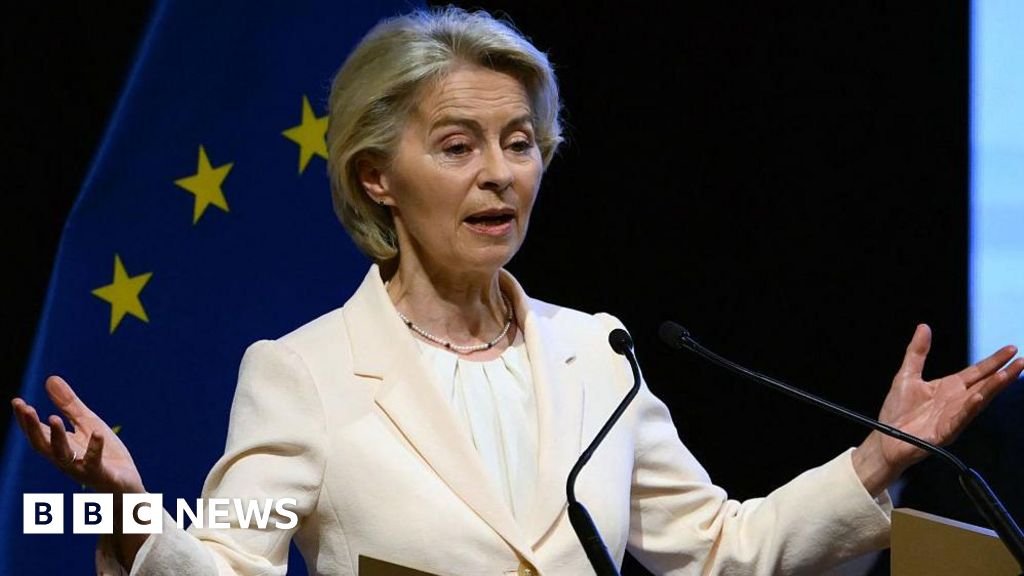
Just six months prior, the US and the EU had come to an agreement aimed at stabilizing their trade relationships. This deal, facilitated by European Commission President Ursula von der Leyen at Trump’s golf resort in Scotland, involved a 15% tariff on EU exports to the US, a significant reduction from the originally threatened 30%.
Possible Retaliation
Brussels had also prepared a comprehensive tariff package to activate if negotiations faltered. This package encompassed a wide range of goods — from livestock to aircraft parts and whiskey, totaling around €93 billion worth of imports from the US. As the European Parliament was poised to endorse this trade deal, Trump’s recent threats led influential German MEP Manfred Weber to assert that such approval was now unattainable.
If the EU does not formalize last year’s agreement, American goods could face tariffs effective February 7, which might provoke a political backlash against Trump from US exporters to Europe. Regarding his selective tariff threats, EU representatives noted that while implementation might be possible, the complications involved with goods crossing multiple borders would present significant challenges.
The ‘Trade Bazooka’ and Its Implications
The so-called “trade bazooka,” officially termed the Anti-Coercion Instrument (ACI), empowers the EU to counter economic pressures from non-member countries. This law allows for stringent responses against nations perceived to undermine the EU’s sovereignty. Potential measures could include tariffs, trade restrictions, and limitations on financial access.
Despite its formidable capabilities, the ACI is regarded as a last-resort option; deploying it could have serious economic repercussions for the EU itself. Furthermore, the process for retaliation is lengthy—investigations could last up to four months followed by additional negotiation time, extending the timeline for any response significantly.
What of the UK’s Position?
UK Prime Minister Sir Keir Starmer has publicly indicated his desire to avoid escalating tensions into a trade war with Trump, suggesting that immediate retaliation is not advisable. While he criticized the use of trade fears as leverage against allies, he underscored that a tariff dispute serves no one’s interests and voiced his intent to avoid such a conflict.
Alternative Strategies
The UK government may still leverage other tools; for instance, it could opt to increase the existing Digital Services Tax, which currently applies a 2% charge on major tech firms with significant revenues. However, legal uncertainties around Trump’s proposed tariffs loom, as the Supreme Court prepares to assess whether his actions under the International Emergency Economic Powers Act were within constitutional limits.
Conclusion
As tensions rise over trade relations, Trump’s tariff threats present a significant challenge to Europe and the UK. The response strategies are complex, and the forthcoming months will prove critical in determining the future of transatlantic trade.
Key Takeaways
- Trump’s tariff threats could significantly impact trade relations between the US and eight European nations.
- The EU has mechanisms, like the Anti-Coercion Instrument, to respond to economic pressures.
- Political backlash against Trump is a concern, especially from US companies reliant on exports to Europe.
- The UK aims to navigate these tensions carefully, seeking to avoid a trade war while considering all available options.