

The Return of the Bayeux Tapestry Fragments to France
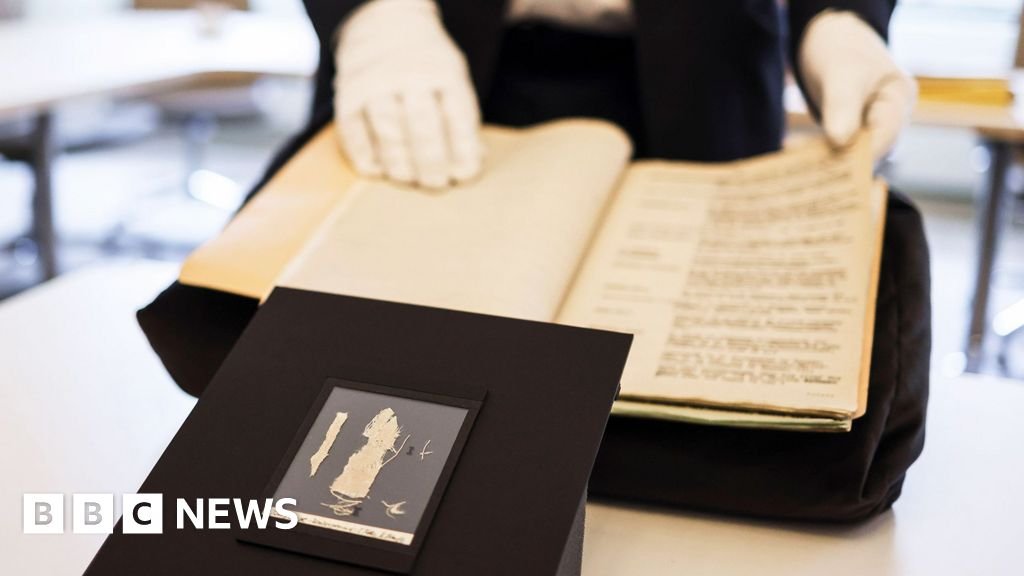
Germany has returned two small fragments of the iconic Bayeux Tapestry, which were taken by a German scientist during the Nazi occupation of France in 1941. These pieces, although unembroidered, are significant to the rich history encapsulated in this medieval artwork. Historians recently unearthed these fragments while delving into state archives in Schleswig-Holstein, where they were stored as part of the collection belonging to Karl Schlabow, a German textile specialist.
The Discovery of the Fragments
The fragments, measuring just a few centimeters, were identified as components of the Bayeux Tapestry—an impressive 70-meter (230-foot) long embroidery that narrates the events surrounding the Norman conquest of England in 1066. Rainer Hering, head of the archive, presented the linen pieces to the mayor of Bayeux, emphasizing that returning them to France was “obvious.”
Historical Context
Schlabow, who passed away in 1984, is believed to have taken the fragments during his research in Bayeux, part of a project linked to the Nazi regime’s distorted view of “ancestral heritage.” This project, fueled by racist and antisemitic ideologies, was sanctioned by Adolf Hitler’s Nazi SS.
In a recent inventory of Schlabow’s collection, conducted in 2023, the historians stumbled upon a glass plate containing these intriguing pieces of fabric. Hering elaborated on this discovery, mentioning that accompanying documents facilitated the identification of the fragments as sections of the Bayeux Tapestry. “For our state archives service, it was clear that these fabric pieces taken by the Nazis 85 years earlier needed to be returned to France,” he remarked to reporters in northern France.
The Bayeux Tapestry: A Treasure of History
It is suspected that the fragments were removed from the back of the tapestry, which illustrates 58 distinct scenes that unfold over two decades, featuring 626 characters and 202 horses. This renowned tapestry captures William the Conqueror’s ascension as the first Norman king of England, depicting his seizure of the English throne from Harold Godwinson at the Battle of Hastings.
The Upcoming Exhibition
The tapestry is set for display at the British Museum in London this September, under a deal that has sparked controversy between the UK and France. Over 77,000 individuals have signed a petition opposing the tapestry’s relocation, citing concerns about its fragility. Prominent UK artist David Hockney recently characterized the transportation of the tapestry across the Channel as “madness,” stating that “some things are too precious to risk.”
Despite the concerns, the British Museum assures the public of its commitment to protecting this historical treasure. The UK government has taken proactive measures, securing an insurance policy for the tapestry valued at £800 million. Recognizing its importance to both British and French heritage, the tapestry was also added to UNESCO’s “Memory of the World” register in 2007.
Conclusion
The return of these fragments marks a significant step towards righting historical wrongs stemming from the Nazi era. The Bayeux Tapestry remains a cherished piece of cultural heritage, and while its journey continues, it stands as a testament to the intertwined histories of France and England.
- Germany has returned two fragments of the Bayeux Tapestry stolen in 1941.
- The tapestry teaches the story of the Norman conquest of England in 1066.
- Concerns about the tapestry’s fragility have led to widespread opposition against its relocation.
- The British Museum is committed to preserving this important cultural artifact.