

Spain’s Roman Catholic Church Reaches Historic Agreement to Compensate Abuse Victims
In a significant move for justice, Spain’s Roman Catholic Church has partnered with the government to offer compensation to victims of sexual abuse by clergy members. This agreement aims to address longstanding grievances regarding the Church’s insufficient response to these serious allegations. By enabling accessible compensation, it not only acknowledges the suffering of countless victims but also seeks to establish a transparent and supportive system moving forward.
The Agreement: A New Path for Victims
This landmark pact outlines a framework in which the government will oversee compensation processes in collaboration with the Church. It will particularly cater to cases that lack other legal avenues for justice, either due to the age of the allegations or the death of the accused. The government estimates that hundreds of thousands of Spanish citizens have experienced abuse at the hands of Church figures.
Justice Minister Félix Bolaños spoke after the agreement was signed, stating, “A democracy should not allow the existence of victims who have never been compensated [and] whose situation, on the contrary, had been covered up.” He emphasized that the objective of the initiative is to address a “historic, moral debt” owed to these victims.
Key Signatories and Their Statements
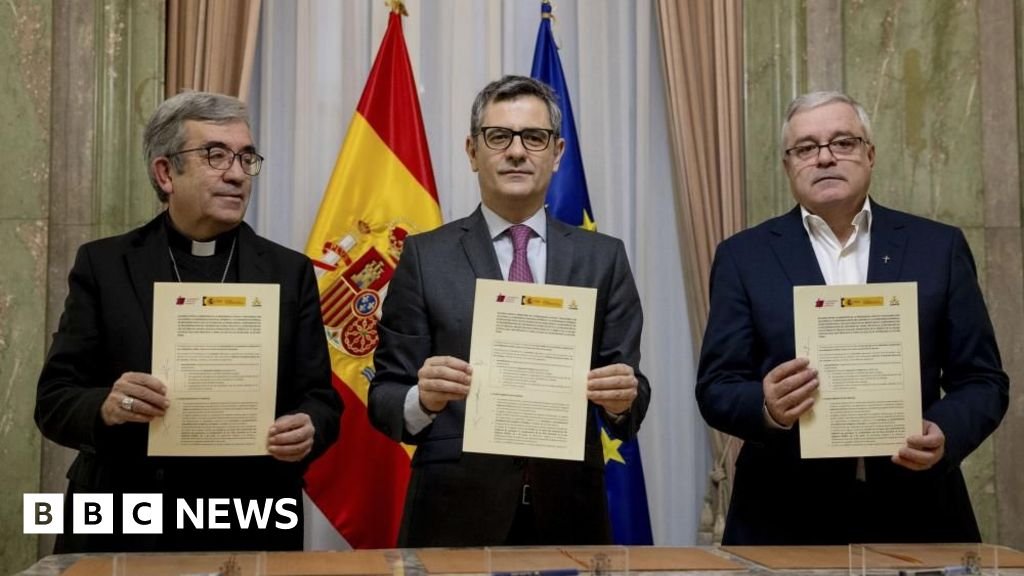
The agreement was signed by several important figures, including:
- Félix Bolaños: Justice Minister
- Luis Argüello: President of the Episcopal Conference
- Jesús Díaz Sariego: President of Confer, representing Catholic congregations
Argüello remarked that this agreement represents a vital step forward in their ongoing journey to address abuses within the Church. Sariego described the initiative as unprecedented, specifically noting its focus on crimes that have long passed the statute of limitations.
Statistics and Previous Attempts at Redress
A study from the Spanish ombudsman’s office in 2023 revealed that about 1.1% of the population, translating to approximately 440,000 people, had suffered sexual abuse linked to the Church. The Church has contested these findings and previously established its own reparation scheme, which has faced criticism for its lack of external oversight.
In November prior to this agreement, the Church announced that 58 cases had been resolved under its framework. Nevertheless, critics highlighted issues of transparency and efficiency, with notable media documentation showcasing claims from 2,948 victims that span several decades.
The Vatican’s Involvement
Following growing dissatisfaction among victims’ groups, the Vatican increased its engagement, with Pope Francis publicly expressing remorse for the Church’s failings. Meetings between Spanish officials and Vatican representatives aimed to encourage the Church to enhance its reparations approach. This has raised the stakes for Church authorities in Madrid.
How the New System Will Work
Under this new system, victims can bring their cases to a newly established agency from the justice ministry. Once filed, these cases will be submitted to the ombudsman’s office for drafting compensation proposals. The Church will then review these proposals and must agree on the compensation details; if they do not, the case reverts back to the ombudsman.
The forms of reparation can include symbolic gestures, psychological support, or financial compensation, although the specifics around financial payouts remain undefined. The ombudsman has suggested drawing comparisons to similar schemes in other European nations.
Comparative Compensation Practices
For context, a comparison with other countries shows that Belgium has offered an average of €6,000 (approximately $7,000), while Ireland’s redress board has dispensed around €63,000 to victims. Such figures have drawn mixed reactions, including critiques from the late Pope Francis, who felt that even the Belgian amounts were insufficient.
Global Perspective on Clerical Abuse
Concern around sexual abuse by clergy members began gaining global attention in the 1980s in North America, with subsequent revelations emerging from countries like Argentina, Australia, and Ireland. While Spain historically had fewer scandals, recent media investigations have brought the issue into the public eye. The resignation of the bishop of Cádiz in November due to abuse allegations serves as a stark reminder of the problem.
Victim Voices Celebrate the Agreement
Victims’ advocacy organizations have expressed their support for this new agreement. Juan Cuatrecasas from the Association for Stolen Childhood (Anir) stated, “This is an endemic, structural evil which has been within the Church and which it should have tackled a long time ago instead of covering up pedophiles.” His satisfaction reflects a broader hope that this pact will lead to genuine redress for victims.
Conclusion
Spain’s agreement with the Roman Catholic Church marks a pivotal moment in addressing the trauma of abuse victims. This cooperative approach not only seeks to provide compensation but also strives to bring transparency and a sense of justice to those who have long suffered in silence.
Key Takeaways
- Spain’s Catholic Church agrees to compensation for clergy abuse victims.
- The government will oversee the compensation process collaboratively with the Church.
- New claims can be filed through a designated agency with proposals routed to the ombudsman.
- The initiative is aimed at resolving cases often beyond the statute of limitations.