

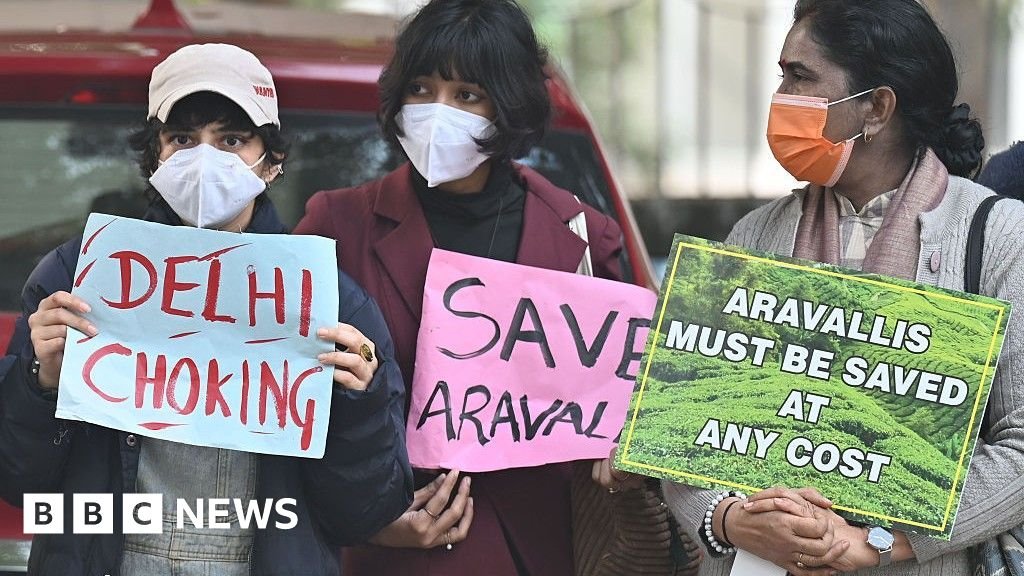
Protests Erupt in India Over Redefinition of the Aravalli Hills
Protests have ignited across northern India following a controversial Supreme Court ruling defining the Aravalli hills—one of the oldest geological formations on the planet—which span several states including Rajasthan, Haryana, Gujarat, and Delhi. Environmental advocates are expressing concerns about potential ecological consequences stemming from the new definition, which may jeopardize these vital landforms.
Understanding the New Definition
The Supreme Court’s ruling came about after recommendations from the federal government. The updated definition classifies an Aravalli hill as any landform that ascends at least 100 meters (328 feet) above the surrounding landscape. Furthermore, two or more hills located within 500 meters of each other, along with the intervening land, form what is referred to as an Aravalli range.
Critics, particularly from environmental circles, argue that this height-based approach may overlook numerous smaller hills that, while not meeting the height criteria, are ecologically significant. These lower, scrub-covered hills play essential roles in preventing desertification, replenishing groundwater, and sustaining local livelihoods. Activists emphasize that the ecological value should not be dismissed merely because the landforms don’t reach a certain height.
Voices of Protest
Peaceful demonstrations have unfolded in urban areas like Gurugram and Udaipur, with participation from local residents, farmers, environmentalists, and some political figures. Neelam Ahluwalia, a founding member of a group dedicated to protecting the Aravalli region, affirms that the new definition could undermine the critical environmental functions the Aravalli range serves in northwestern India.
Vikrant Tongad, another environmental activist, stresses that mountains and hills should be recognized for their ecological and geological contributions rather than simply their elevation. He calls for a scientifically-driven definition encompassing geography, ecology, wildlife connectivity, and climate resilience, warning that the new ruling could foster increased mining and construction activities—putting the delicate ecosystem at risk.
Opposition leaders have also voiced their concerns. Akhilesh Yadav, chief of the Samajwadi Party, noted that without the Aravalli hills, the entire Delhi area could face severe ecological degradation. Rajasthan Congress leader Tika Ram Jully echoed this sentiment, labeling the range as the state’s lifeblood.
Government’s Stance
The federal government has attempted to alleviate fears surrounding the redefinition. In a recent statement, officials clarified that the intention behind the new definition is to enhance regulatory measures and create consistency in how mining practices are managed across states. They emphasized that the entire hill system is protected by this definition, ensuring that hill clusters and their interconnections are not at risk.
Officials added that the new definition does not suggest that all landforms under 100 meters are open for mining; in fact, new mining leases are prohibited in specific areas deemed “inviolate,” including protected forests, eco-sensitive zones, and wetlands. Current mining operations may continue only if they adhere to sustainable practices.
However, environmental advocates remain skeptical, insisting that their protests will persist, and they are exploring legal avenues to contest the court’s decision.
- Protests have erupted in northern India against the Supreme Court’s redefinition of the Aravalli hills.
- Environmentalists argue that the new definition disregards ecologically vital hills under 100 meters.
- The federal government maintains the definition aims to strengthen regulations and protect ecological areas.
- Demonstrations are set to continue as activists seek legal challenges to the ruling.