

Journalists Released Pending Trial: A Reflection on Press Freedom in Turkey
In a notable development for press freedom in Turkey, four journalists were released on Monday while awaiting the results of their trial. This case is emerging as a significant indicator of the current state of media liberty in the country.
The Defendants and Their Allegations
Among those released are well-known investigative journalists Ahmet Sik and Nedim Sener. They, alongside their colleagues Coskun Musluk and Sait Cakir, had been detained for 375 days, accused of operating within the media faction of Ergenekon—a clandestine ultranationalist group purportedly plotting to topple the ruling Justice and Development Party (AK Party). All individuals involved have denied any wrongdoing.
Court Rationale for Release
The Istanbul court decided to free the journalists, attributing their decision to the potential for a change in the categorization of the alleged crime and the extended time already served in custody. This news was reported by the semi-official agency, Anatolia News Agency.
Official Reactions
Deputy Prime Minister Bulent Arinc expressed satisfaction with the release, stating, “Long periods under custody should not turn into punishment,” during a televised address that welcomed the news.
Continued Detention of Others
Despite the positive turn for some, six additional suspects remain behind bars, including the editors of Oda TV, a strongly secular online outlet critical of the AK Party.
Voices for Freedom
Following his release, journalist Sik emphasized that this situation extends beyond mere press freedom; it pertains to the fundamental right to express oneself. “Freedom of expression is not just a problem for journalists,” he noted, pointing out that many students and citizens are incarcerated due to restrictive anti-terrorism laws.
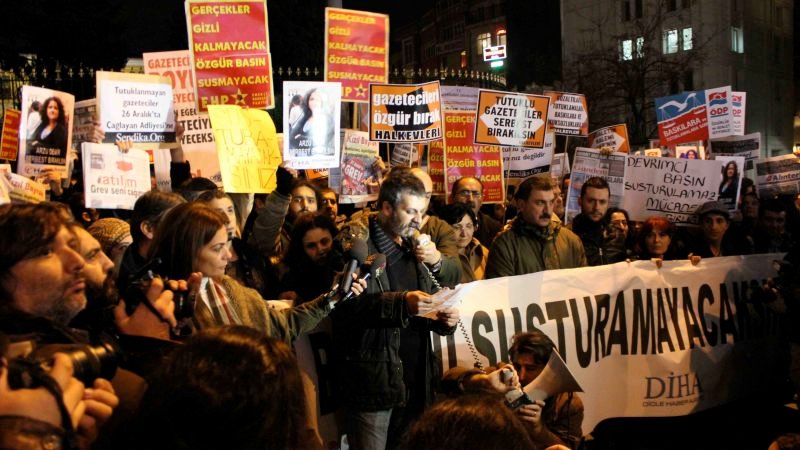
A celebratory crowd gathered outside the prison, waving Turkish flags and chanting, “Free press cannot be silenced.”
International Criticism
The AK Party faces intense scrutiny from various international bodies, including the United States and the European Union, over its treatment of journalists. Organizations dedicated to press freedom have strongly condemned the Turkish government’s actions.
Following the journalists’ release, the Committee to Protect Journalists stated, “The government must go beyond this mere gesture and release all journalists incarcerated under Turkey’s vague penal and anti-terror laws.” They emphasized the urgent need for fundamental legislative reforms.
The Current Landscape
Turkey stands among the countries with the highest number of journalists imprisoned globally, with around 100 currently facing trials or serving sentences, predominantly from Kurdish backgrounds.
The government maintains that these journalists are not facing charges due to their work, although critics assert that the aim of these prosecutions is to suppress dissent.
Personal Accounts
Prior to his arrest, Sik authored a book addressing the infiltration of Turkish law enforcement by followers of Fethullah Gulen, a cleric residing in Pennsylvania. Police confiscated draft copies of his work upon his arrest. “Justice will be served when those who made up these allegations against us are put in prison,” he stated following his release.
Sener, a journalist for the daily Milliyet, had reported extensively on the assassination of Armenian journalist Hrant Dink. He accused state authorities of ignoring warning signs before Dink’s murder. After his release, Sener affirmed his commitment to uncovering the truth behind the Dink case: “The truth cannot be imprisoned.”
Looking Ahead
The next court hearing in this pivotal case is scheduled for June 18, with many watching closely as the situation evolves.