

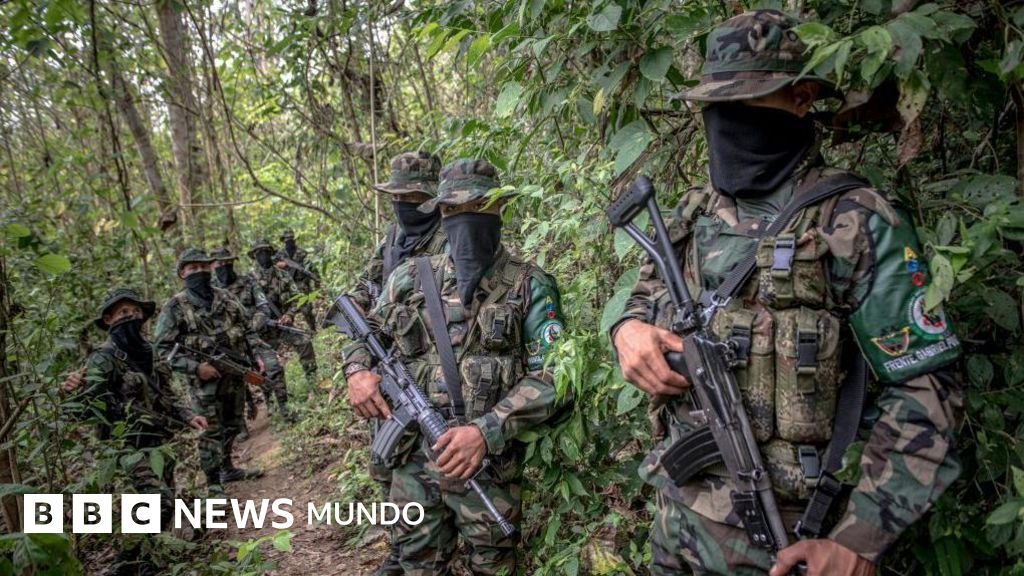
Understanding the Gaitanista Army of Colombia
In recent months, the United States has taken significant steps in its campaign against drug trafficking and organized crime in Latin America, spotlighting the Gaitanista Army of Colombia (EGC), commonly referred to as the Gulf Clan. This declaration by the U.S. State Department, designating the EGC as a foreign terrorist organization, sheds light on the intricate dynamics of this powerful criminal group and its impact on regional stability and security.
The Designation and Its Implications
The EGC, which asserts it operates with political motives, is recognized as Colombia’s most formidable criminal organization. According to U.S. officials, it boasts thousands of members whose primary revenue source is cocaine trafficking, funding its violent activities. This designation marks the fourth Colombian group to be added to the U.S. list of foreign terrorist organizations, joining the ranks of groups such as the National Liberation Army (ELN) and dissident factions of the Revolutionary Armed Forces of Colombia (FARC).
With escalating tensions in Latin America, the U.S. military has been actively targeting suspected narcotics vessels in both the Caribbean and South Pacific, resulting in numerous fatalities. U.S. President Donald Trump’s statements suggest that ground operations may soon extend into Venezuela. Trump has accused Venezuelan President Nicolás Maduro of leading a criminal organization known as the “Cartel of the Suns,” allegations that Maduro denies. Furthermore, the possibility of U.S. actions in Colombia, the world’s largest cocaine producer, has incited robust backlash from Colombian President Gustavo Petro, who is navigating sanctions tied to alleged drug trafficking connections.
Amidst this backdrop, the Gulf Clan is involved in negotiations with Petro’s government as part of the “total peace” strategy. The U.S. classification of the EGC as a terrorist organization raises questions about the future of these discussions.
Origins and Growth of the Gulf Clan
The EGC emerged from remnants of the paramilitary groups that plagued Colombia in the 1990s, particularly the Popular Liberation Army (EPL) and the United Self-Defense Forces of Colombia (AUC). Following disarmament, former members from these opposing factions unified, forming what has evolved into a purely criminal organization rather than one with genuine political intentions.
Research indicates that the EGC has established a presence in over 302 of Colombia’s approximately 1,100 municipalities, enabling dominion over various illegal revenue streams, including extortion, drug trafficking, and illegal mining. The group’s adaptability in the face of law enforcement challenges allows it to thrive.
Victor Barrera, an investigator at the Center for Research and Popular Education in Bogotá, emphasizes the group’s mobility, stating that they often subcontract to adapt to prevailing circumstances. This method complicates tracking their operations and allows for the rapid replacement of captured leaders. Currently, the EGC is estimated to have around 9,000 members, a number likely to increase as new counts are conducted.
Leadership Structure
For almost 15 years, the EGC was led by Dairo Antonio (Otoniel) and his brother Juan de Dios Úsuga. Following Otoniel’s capture and extradition to the U.S. in 2021, where he is now serving a 45-year sentence, the organization has shifted leadership. The recent rise of figures like Wílmer Giraldo, known as Siopas, and Jesús Ávila, nicknamed “Chiquito Malo,” highlights a rapidly evolving power dynamic within the group.
Recent Developments and Negotiations
Experts have pointed out that the EGC’s operational model, which emphasizes local collaboration over open confrontations, has allowed for continued territorial expansion. Even amidst the COVID-19 pandemic, they diversified their approaches, providing goods and services while capitalizing on the migration crisis in the region to gain financial ground.
Since President Petro’s administration began, the approach towards negotiating with the EGC has sparked public skepticism. Many question how a criminal organization could realistically disarm and abandon its lucrative control over territories. In recent discussions held in Doha, Qatar, an agreement was signed to progressively work towards potential disarmament, yet time is not on Petro’s side.
As U.S. actions against drug trafficking show no signs of slowing, concerns are growing about the impact on peace negotiations, as international scrutiny continues to mount over the EGC and its operations. Any perceived threats to Colombia’s sovereignty from U.S. interventions have been labeled by Petro as “a declaration of war.”
Conclusion
The situation surrounding the Gaitanista Army of Colombia remains complex and fraught with uncertainty. As the U.S. maintains its hardline stance against drug trafficking, the future of Colombia’s internal peace efforts hangs in the balance, raising questions about the possibility of disarming a group so deeply embedded in the socio-economic fabric of the country.
Key Takeaways
- The Gaitanista Army of Colombia, also known as the Gulf Clan, is now classified as a foreign terrorist organization by the U.S.
- With about 9,000 members, the group is engaged in various illegal activities, including drug trafficking and extortion.
- Leadership changes within the EGC continue to shape the organization’s direction after the capture of Otoniel.
- Ongoing negotiations between the EGC and the Colombian government face skepticism, with external pressures complicating the peace process.